At A Glance
- Elderly care staff need to make sure residents are kept safe without limiting their access to the facility
- However, protecting storage spaces and areas with high-risk equipment, such as cleaning cupboards, is highly recommended
- By installing specific lock types, such as magnetic locks and keyed locks, you can make sure your care home remains safe for all
- Choose locks based on staff workflow and resident safety requirements to improve safety around your care home environment
In elderly care homes, it’s increasingly common to see baby cupboard locks in use. These lock types are perfect for protecting access to areas of the building that could potentially put residents at risk. At the same time, they remain easy enough to use that staff can do their job unimpeded.
Are you unsure which kind of baby cupboard locks you should choose? Then you are in the perfect place to get some answers. This guide, brought to you thanks to insights from Locks & Handles, will help you find the ideal cupboard child locks that keep your residents safe without making life more challenging for your staff.
Use these recommended cupboard locks for elderly care homes to ensure residents stay safe and staff can get on with their jobs.
Why Baby Cupboard Locks Are Appropriate For Care Homes
Look, we understand there is a bit of stigma around installing baby cupboard locks in an elderly care home. Does it feel a little patronising? On the face of it, potentially yes.
However, keep in mind that most children’s door locks are ideal for elderly residents. The locks themselves are easy to install, and you can use them for your staff. However, they remain difficult to force open, meaning elderly residents can be protected from hurting themselves by exploring the wrong areas of the care home. In an environment where physical and cognitive limitations are rife, this is key.
Locks do one simple thing: they prevent residents from gaining access to places they should not. The advice we received from Locks & Handles was to install baby cupboard locks on storage areas where resident access is not permitted. For example, this could be where your staff store the cleaning equipment or where medication is kept.
Installing these locks limits residents from walking into hazardous situations. At the same time, the use of baby cupboard locks means staff can still open the doors easily. We recommend using these baby cupboard locks for this reason: staff will not feel impeded, while residents will be kept safe.
Remember, in most care homes, there will be residents who have cognitive decline. They could mistake a cleaning cupboard or medical storage cupboard for a different room. By installing these simple child cupboard locks, you prevent them from accidentally walking in and getting lost or hurt.
What are the best choices, though? There are, after all, many forms of baby cupboard lock. Locks & Handles staff recommend that you look into the following types of locks for care homes:
The Best Cupboard Lock Options For Care Home Security
So, if the goal is to keep residents safe without impeding staff working conditions, where do you start?
Soft-Close Lock Mechanisms
First and foremost, make sure that any locks you buy for care home living spaces are soft-close. Soft-close locks are very important because they prevent doors from slamming shut on residents.
Residents with physical limitations might struggle to get through the door before it closes. If their lock is not a soft-close lock, it could mean the door slams shut on them and hurts them. Soft-close lock mechanisms are designed to close slowly, removing all the force and effort from the closing.
That means less risk of residents getting caught in the door or not being able to get through it quickly enough. It’s a simple solution, but one that may help prevent residents from being startled or harmed.
Magnetic Locks
Magnetic locks are great for areas where staff need quick access, but residents should not be able to enter. These locks prevent the door from being forced open, and there is no lock hole to pick, so you don’t need to worry about criminals popping these doors open, either.
Magnetic locks can also be integrated into a broader access control system, which is becoming increasingly popular in care home settings. Staff can also use magnetic keys to temporarily disable locks so they can get inside, do what they need to do, and get back out to assist your residents. Either way, magnetic locks are a useful, easy-to-use mechanism that avoids the need for a key for every door.
Keyed Locks
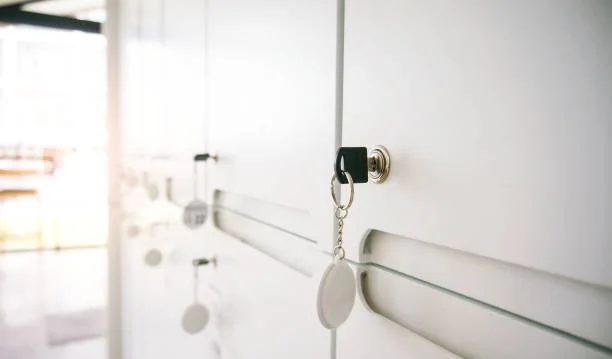
For high-risk areas, such as cleaning cupboards or medical supply storage, Locks & Handles recommends installing a keyed lock.
Keyed locks are pretty standard, but they provide a highly effective solution for most care homes areas where resident access is never required. We do not recommend keyed locks for every door, though, as it can slow your staff down too much, requiring them to go request the keys to open the door. You could use a keyed-alike lock system to ensure easy access to multiple doors with a single key set.
Just remember, though, that if any staff lose their key(s), you will need to replace the locks and any associated keys. That can significantly increase the cost, so use keyed locks only where essential.
Choose Your Locks For Each Specific Scenario
The simple rule is to choose the appropriate lock type for all doorways, storage areas, etc., based on your staff and residents’ needs.
Sometimes, you might just need to add baby cupboard locks to cupboards where you store cleaning equipment and medical supplies. Other times, you might need something a little more robust.
Not every care home will want to go down the route of using keyed locks, for example. Instead, they may use keyless smart lock systems. Others may prefer to use more magnetic locks, as well. Tailor the choice of locks to how your staff work, where they need access, and, of course, the best ways to keep residents safe and comfortable.
There is no universal rule, but with care homes, one thing is clear: keep staff efficient and residents safe. If you focus on that as your main objective, it should be easy to find the right kind of locks.