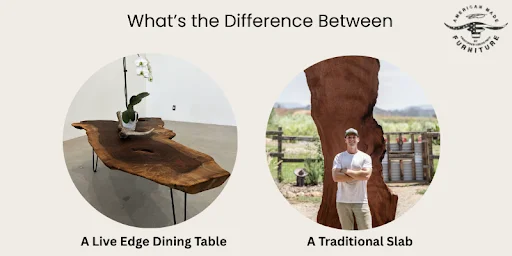
Dining spaces are the centre point for any home. Hence the furniture being placed here are just as important. It is the choice between the live-edge dining table and the refined traditional table for your home that has taken over San Diego in recent times.
As both are equally important in interior design but differ in aesthetics, making the choice can be quite a challenge. Most of the public in Southern California is in search of a unique centerpiece; hence, understanding the difference between the two choices is important. For this, here is a guide to help you make a choice between the handcrafted Live Edge Dining Table San Diego or your regular design.
Top 5 Tips to Decide Between a Handcrafted Live Edge Dining Table and a Regular Dining Table
1. Design Philosophy: Nature’s Blueprint vs. Human Precision
Live Edge Dining Table:
To honor the natural story of the tree is the main design philosophy of a Live Edge table.
Hence, various popular artisans like Kristopher Krickpatrick do not believe in imposing a rigid shape. Instead, they design according to the natural contours of the wood. The method believes in collaboration with nature, where each crack, knot, or unique sweep of grain results in the final form. The main aim is to create a ‘functional art’ that feels both alive and connected to nature.
So, you see, when you are searching for a live edge dining room table, you are not just buying furniture but also preserving a ‘piece of the landscape.’
Traditional Slab Table:
On the other hand, the traditional tables are created by applying human order and precision. In this case, the designing process begins with a predetermined geometric shape. Next, the wood is milled for precise specifications, while the natural irregularities are eliminated for better symmetry. Importance is given to clean lines that are integrated into the structured interior scheme.
Dig deeper with related post that expand on what you just read—click here!
2. Edge Style: The Defining Characteristic
Live Edge Dining Table:
The ‘Live Edge’ is more of a signature design. This is done by retaining the outer bark edge of the tree on one or both of the long sides of the table, also known as the ‘Waney edge’. Next, this raw edge is sanded smooth and sealed but left in its organic and undulating state. Here, the natural cracks filled with clear epoxy for stability are retained, along with dramatic curves and inclusions. This is the raw and unfiltered beauty that people value in live edge wood in San Diego.
Traditional Slab Table:
On the other hand, the traditional slab table comprises straight, crisp, and machined edges. Next, all four sides undergo a perfect cut at 90-degree angles to create a sharp perimeter. The edge profile can be rounded over or bullnose, decorated with routing, or beveled. This is retained in the final design, where the natural boundary of the tree is completely obscured.
3. Craftsmanship & Construction: Artisan Story vs. Manufactured Replication
Live Edge Dining Table:
Here, craftsmanship is the most important. This is clearly noticed in Kristopher Krick’s process, which is popular for its stunning Live Edge Dining Table San Diego:
- Sourcing:
A 100% hand-selection of the reclaimed deadfall slab from the Pacific Northwest forest.
- Preparation:
These are air-dried for three years, followed by kiln drying to prevent warping.
- Artisan Techniques:
Next the resins are used to stabilise the cracks,grain detailing is preserved through hand-sanding, and applied with a custom finish to protect. This further enhances the original character and results in each table being a unique project.
Traditional Slab Table:
Construction is often about efficiency and replication. Here, the construction comprises both replication and efficiency. A standardized process is applied where high-quality traditional tables use fine woodworking techniques. Uniform milling of the slabs is done, and they are joined for width where the edges are routed regularly. Thus, this can be mass-produced or custom-made easily.Here the goal is repeatable with flawless finishing instead of highlighting the unique imperfections.
4. Material Uniqueness
Live Edge Dining Table:
Here, the material is the main feature, where the Live-edge slabs are selected for their unique flaws and character marks, such as burled grain, natural spalting, and mineral streaks.
When searching for the ideal live edge dining table near me, bear in mind that it is, in fact, the search for a ‘wood with a personality.’
The search for the perfect live-edge dining table near me is a search for a specific piece of wood with a personality that resonates with you.
Traditional Slab Table:
Material selection comprises prioritizing consistency, uniform color, and a predictable grain pattern. Here the wood type that can be seamlessly joined and finished into a homogenous surface is selected. Likewise, figured wood such as birdseye maple can also be used. However, in this case it is trimmed to create symmetry instead of just individuality.
This is more of an elegant, versatile, and timeless style. It offers an anchored, serene foundation in the room, where it complements instead of dominating the interior. The ‘Slab tables’ are perfect for dining rooms and classic interiors where a sense of calm is required. Its beauty lies in the quiet confidence it offers.
5. Functionality & Practicality: Natural Form vs. Tailored Utility
Live Edge Dining Table:
- Pros:
Beautiful intimate seating nooks for curved areas can be curated with the help of the organic shape of these pieces. Also, Epoxy-filled rivers and voids offer stunning visuals and are durable too.
- Cons:
The irregular edge might not be suitable for linear seating. There are some natural features that need specific care. Hence, custom sizes and bases such as steel or hybrid frames are also required to support this unique piece of furniture.
Traditional Slab Table:
- Pros: With the help of predictable geometry, optimal space planning, standard table linens, and seating arrangements are ensured. Also, these can easily be clubbed with the existing chairs and other furniture.
- Cons: Appears less unique or expressive and can also lack the sensory appeal as offered by the natural edge.
Conclusion
So, what are you going to choose? Refer to the following if you are still confused:
Choose a Live Edge Dining Table if you:
- If your choice of furniture is more of a functional art.
- Require a unique piece with a natural story.
- Perfect for an organic, warm, and conversation-starting focal point.
- Appreciate and support local artisans like Kristopher Kirkpatrick.
Choose a Traditional Slab Table if you:
- If you like clean lines, symmetry, and a timeless look.
- Require predictable dimensions for a formal dining space.
- Require furniture that smoothly merges into different décor styles.
- Prefer uniformity and classic elegance instead of ‘raw’ character.
Whatever your choice might be, it is important to ensure they are in sync with your preferred style and authenticity. Also, these should merge well into your existing space and functionality.
Ready to explore more? Check out additional posts that take you further!