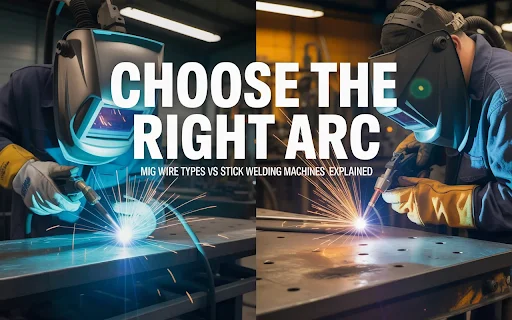
Welding might look like one skill from the outside, but once you step into it, you quickly realize there are many choices that shape the final result. The type of wire you use in MIG welding, and the kind of machine you pick for stick welding, can completely change how smooth, strong, or clean your weld turns out.
That’s why understanding MIG welding wire types is not just a technical detail—it’s the foundation of good welding. At the same time, knowing when and why to use a stick welding machine helps you handle tougher environments where MIG welding might not be the best choice.
Different jobs need different arcs. And choosing correctly saves time, effort, and frustration.
Why Welding Choices Matter More Than People Think
Many beginners assume welding is mostly about skill. While skill is important, the equipment and materials you choose matter just as much.
Think of it like cooking. You can be a great chef, but if you use the wrong ingredients, the dish won’t turn out right. Welding works the same way. The wire type, shielding method, and machine style all influence the final result.
This is especially true in MIG and stick welding, where small adjustments can lead to very different outcomes in strength and appearance.
Understanding MIG Welding Wire Types
In MIG welding, wire is not just “wire.” There are different types designed for different materials, environments, and results.
Understanding mig welding wire types is essential for achieving stability and consistent weld quality.
Generally, MIG wires fall into a few key categories:
- Solid wire
- Flux-cored wire (gas-shielded)
- Flux-cored wire (self-shielded)
Each one behaves differently.
Solid wire is commonly used with shielding gas. It produces clean, smooth welds with minimal spatter. It’s often preferred for indoor work where wind is not a problem.
Flux-cored wire, on the other hand, contains flux inside the wire itself. This helps protect the weld from contamination. Some types still use gas, while others do not.
Self-shielded flux-cored wire is especially useful outdoors. Wind won’t easily affect the weld because the protection comes from the wire itself.
This flexibility is what makes MIG welding so widely used. You can adjust your setup based on the environment and material.
How Wire Choice Affects Your Weld
Choosing the wrong wire can lead to several problems:
- Excess spatter
- Weak penetration
- Porosity (tiny holes in welds)
- Unstable arc behavior
On the other hand, the right wire makes welding smoother, more stable, and more predictable.
For example, using solid wire without proper gas flow can ruin weld quality. Similarly, using flux-cored wire indoors without proper ventilation can create unnecessary smoke and mess.
So it’s not just about what works—it’s about what fits the situation.
When MIG Welding Is Not Enough
MIG welding is efficient, clean, and easy to learn. But it has limits.
Outdoor conditions like wind, rusted metal, or thick structural work can reduce its effectiveness. In those situations, stick welding becomes a better option.
This is where a stick welding machine becomes important. Stick welding, also known as SMAW (Shielded Metal Arc Welding), uses a coated electrode instead of wire.
The coating produces a protective shield when burned, which allows welding in rough environments where MIG might struggle.
Why Stick Welding Is Still Widely Used
Even though MIG welding is popular, stick welding is far from outdated. In fact, it’s still widely used in construction, repair work, and outdoor projects.
One major reason is simplicity. Stick welding does not require shielding gas. That means fewer components and less setup.
It also performs well in windy or dirty environments. Rust, paint, or outdoor conditions are less likely to interfere with the weld.
This makes it extremely useful for field work or heavy-duty repairs.
MIG vs Stick: Understanding the Difference
The difference between MIG and stick welding is not about which one is better. It’s about which one is right for the job.
MIG welding is:
- Cleaner
- Faster
- Easier for beginners
- Best for controlled environments
Stick welding is:
- Strong in outdoor conditions
- Better for thick or dirty metal
- More portable
- More forgiving in rough environments
Both methods have strengths. A skilled welder often knows how to use both depending on the situation.
Choosing the Right Arc for the Job
The term “arc” in welding refers to the electrical discharge that melts the metal. But in practice, choosing the right arc means choosing the right welding method and setup.
If you need precision and speed, MIG welding with the correct wire type is ideal. If you need strength in difficult conditions, stick welding is often the better choice.
The key is not forcing one method into every situation. Instead, match the tool to the task.
That decision alone can dramatically improve weld quality.
Common Mistakes Beginners Make
A lot of welding problems come from simple misunderstandings.
Some common mistakes include:
- Using the wrong MIG wire type for the job
- Ignoring environmental conditions
- Choosing MIG when stick welding is more suitable
- Not adjusting settings for material thickness
These mistakes don’t mean someone is unskilled. They just mean the setup wasn’t fully aligned with the task.
Once corrected, results improve quickly.
How YesWelder Helps Simplify the Choice
Modern welding equipment aims to reduce confusion, not increase it. Brands like YesWelder design machines that support different welding needs, helping users switch between techniques more easily.
With clearer controls and more accessible designs, welders can focus on learning instead of struggling with complicated setups.
This is especially helpful when working with both MIG wire selection and stick welding equipment. A smoother machine experience makes the learning curve less steep and more manageable.
Final Thoughts
Welding is not just about melting metal together. It’s about choosing the correct combination of method, material, and machine.
Understanding mig welding wire types helps you control quality in MIG welding. Knowing when to use a stick welding machine gives you strength and flexibility in tougher environments.
There is no single “best” option. There is only the right choice for the situation.
Once you understand that, welding becomes less confusing and far more powerful. You don’t just weld—you decide how to weld, and that makes all the difference.
Hand-picked for impact: The insight our team swears by this week at Management Works Media.