Buying a kids microscope is easy to get wrong. Use this quick guide to choose the right type, avoid the common traps, and get one your child will enjoy from day one.
Start With The Right Microscope Type For Your Child
Before you compare prices or magnification numbers, choose the microscope style that matches your child’s patience level. This is the part most parents skip, and kids microscope is why many microscopes end up unused.
Digital Microscopes Work Best For Quick Success
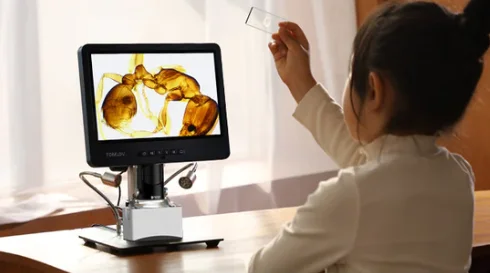
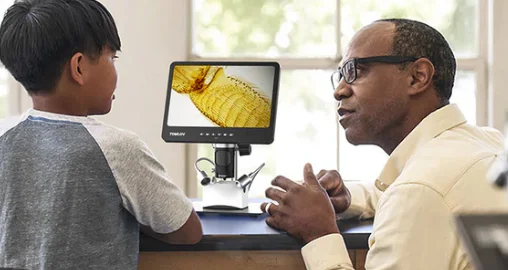
If your child is young or gets bored easily, a digital microscope is usually the easiest choice. Instead of looking through an eyepiece, your child sees the magnified view on a screen. That alone removes a lot of the struggle.
Digital microscopes are a great fit when you want something that feels fun right away. Kids can look at everyday objects and immediately see details they have never noticed before. If you want a microscope for kids that feels simple from the first try, digital is often the safest place to start.
A digital microscope is usually a good pick if:
- your child is under 9
- you want something they can use with minimal help
- you want easy “wow” moments at home
Before buying, check three things:
- The image looks clear at normal zoom, not just the highest number
- Focus is smooth and easy to control
- The microscope stays steady on a stand
Picture this. Your child grabs a leaf from the backyard and wants to see the tiny lines and texture. A digital kids microscope lets them see it instantly, without having to line up their eye perfectly or constantly adjust their position.
Optical Microscopes Make Sense For School-Style Learning
Optical microscopes are the classic kind with an eyepiece. They feel more “real” and they are great for prepared slides and science projects. They can also teach kids patience and focus control, which is a skill on its own.
Optical microscopes are better when:
- your child is older and can follow steps
- they want to use prepared slides
- you need it for school labs or science fairs
The main thing to know is that optical microscopes take practice. The first few times your child uses it, you might need to help them find the object and focus it. Once they get it, it becomes much easier.
A common example is a school project like onion skin cells. That kind of viewing works well on an optical microscope with decent lighting, because slides stay stable and the image is easier to sharpen.
Ignore Big Magnification Claims And Focus On Clarity
A microscope that claims “1200X” sounds impressive, but that number does not guarantee a good experience. In fact, high magnification is often where cheaper microscopes fall apart.
Why High Magnification Often Looks Worse
Magnification only helps when the lenses and lighting are strong enough to support it. If the optics are low quality, the image becomes blurry and dim, even if the microscope technically “zooms in.”
If parents complain about microscopes online, it is usually because of one of these issues:
- everything looks blurry no matter what
- the focus never feels sharp
- the image is too dark to see details
A much better approach is to buy a microscope that looks clean and sharp at low and medium zoom. That is where most kids spend their time anyway.
Here is a simple test: if the microscope cannot show hair or fabric fibers clearly, it probably will not show anything interesting at extreme zoom.
What Kids Actually Like To Look At
Most kids do not start by studying tiny cells. They start with fun, familiar objects. The best microscope supports that kind of exploring.
Some of the easiest and most satisfying beginner samples are:
- a strand of hair
- paper texture
- a piece of fabric
- salt or sugar crystals
- a leaf or flower petal
- prepared insect slides
These objects give fast results and keep kids interested long enough to learn how focusing works.
Make Sure Your Child Can Focus It Without Constant Help
You can buy an expensive microscope and still end up with a frustrated child if focusing is difficult. Ease of use is what turns a microscope into a hobby instead of a one-time toy.
What Makes Focusing Easy For Kids
Kids succeed faster when the microscope is stable and the controls feel smooth. A microscope that wobbles or slips around makes focusing harder than it needs to be.
Look for:
- a stable base that does not tip easily
- a focus knob that moves smoothly
- a stage that holds the slide in place
When your child uses it for the first time, teach them one rule that solves most problems.
Start on the lowest magnification first.
That is the biggest mistake kids make. They jump to the highest zoom, lose the object, and then assume the microscope does not work.
A simple focus routine that works for most kids:
- Start at the lowest magnification
- Place the slide or object flat and steady
- Turn the focus knob slowly until it looks sharp
- Only then move up to a higher level
This saves a lot of frustration and makes kids feel like they are doing it “right.”
Lighting Matters More Than Parents Expect
If the image looks dark, kids lose interest fast. They think it is broken, or they think microscopes are boring.
Built-in LED lighting is usually the easiest option for families. It works indoors at any time of day, and it helps objects look clearer. If the microscope has adjustable brightness, even better.
A real-life situation: your child wants to look at something after dinner, but the room lighting is not bright enough. A microscope with proper built-in light keeps the image clear and prevents the “I can’t see it” moment.
Choose A Microscope That Can Handle Real Kid Use
Kids are not careful on purpose. They are just being kids. A microscope should survive normal bumps and curious hands.
Stability And Build Quality Make A Big Difference
A microscope should feel steady when your child touches it. If it shakes every time they turn the focus knob, the image will never stay clear.
Good signs:
- heavier base
- tight parts that do not wobble
- slide holders that actually grip
Microscopes that feel very lightweight and loose often become frustrating quickly, even if the listing photos look cute.
Do Not Get Distracted By Huge Accessory Kits
Some microscopes come with dozens of extras, but most of them never get used. What you want is a kit that helps your child succeed quickly.
The most useful accessories are:
- prepared slides
- a few blank slides and cover slips
- a simple storage case
- basic tools like tweezers or a dropper
Prepared slides are especially helpful because they give instant results. Your child can see something cool immediately, which builds confidence and keeps them interested.
Pick A Budget That Matches Your Child’s Interest
You do not need to spend a lot to get a good microscope. The best budget depends on how serious your child is about science right now.
A Starter Microscope Is Perfect For Curious Beginners
If your child is just exploring, a beginner-friendly model is enough. The main goal is to keep it simple and fun.
A starter microscope should be:
- easy to use
- clear enough for common objects
- quick to set up again later
This is a solid choice for birthdays, holidays, or a first science gift.
A Better Microscope Is Worth It For Long-Term Learning
If your child is already into science, nature, or school experiments, it makes sense to invest a little more. A stronger microscope lasts longer and stays enjoyable as your child learns more.
What improves the experience long-term:
- sharper image quality
- better lighting
- more stable focusing
- compatibility with standard slides
If your child keeps asking questions and wants to explore deeper, a higher-quality microscope helps them stay interested instead of hitting a wall.
Final Thoughts
The best kids microscope is not the one with the biggest magnification number. It is the one your child can use easily, see real results with, and feel excited to try again.
When you focus on clarity, simple focusing, good lighting, and a stable build, you avoid most buying mistakes. More importantly, you give your child a tool that makes science feel fun and approachable.
Once you know what to look for, choosing the right microscope for your child becomes much easier, and your child is far more likely to stick with it.
Unlock Tools That Simplify Your Success at Management Works Media.