Our climate in Australia is like that of a bone-dry heat one minute and a thunderstorm the next. This is a difficult task to deal with dust in commercial projects. Previously, the answer was easy, blow up the site with millions of litres of water.
But today? That doesn’t fly. We cannot say that we are creating green commercial centers and emptying the local water supply to keep the dirt under. And then there is the fact that plain water just evaporates after twenty minutes anyway.
So, what works when you are dealing with a sustainable project? What is the trade off between accomplishing the job and maintaining the air clean?
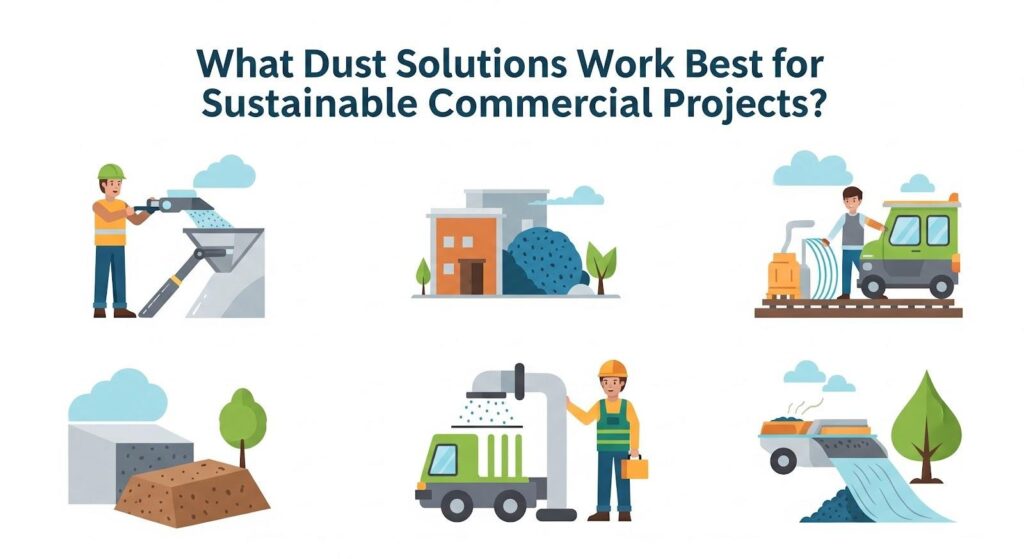
The following are the solutions that are transforming the game.
Eco-Friendly Water Truck Upgrades: Wetting Agents and Efficiency
The water cart was the sole tool of the shed, over decades. Although water is not going to be useless, the use of water 100 percent is becoming a thing of the past.
Why? Water has high surface tension.
When you spray plain water on dusty soil, it will not sink in but will bead up and will run off. This leaves a muddy mess and dry spots and you have to keep on applying it. It is costly, unproductive and inefficient.
The Fix: Wetting Agents
Wetting agents are being used in modern sustainable projects. These are non-toxic additives which disrupt the surface tension of the water.
- They render water “wetter”: The moisture is soaked in the ground.
- They conserve resources: You consume much less water to achieve the same outcome.
- They save time: An application of them takes a lot longer than plain water.
It is a chemical adjustment that checks a large box on your budget and your Green Star rating.
Biodegradable Soil Binders: The Future of Dust Control Chemistry
To be serious about the issue of sustainability, the soil itself must be considered. The shift towards biodegradable soil binders is one of the best changes we have ever observed.
Consider it to be a green glue. When you spray these binders onto a stockpile or a cleared site they form a crust. This crust glues the dust particles in place to ensure that they are not lifted by the wind.
The new generation of polymers is usually of a plant origin as compared to the old-school petroleum products (which were simply spraying of oil on the ground). They decompose naturally over time without damaging the soil.
This is where strategy comes in. By using high-tech dust suppression techniques such as polymer coating, you are not simply wetting the ground. You are designing the surface to withstand wind.
On a commercial site that may not be busy during a long weekend, a good polymer seal may be able to sustain weeks. No water trucks on all weekend. No grievances by the neighbours. That is true sustainability.
Advanced Dust Suppression Systems: Fog Cannons and Misting Technology
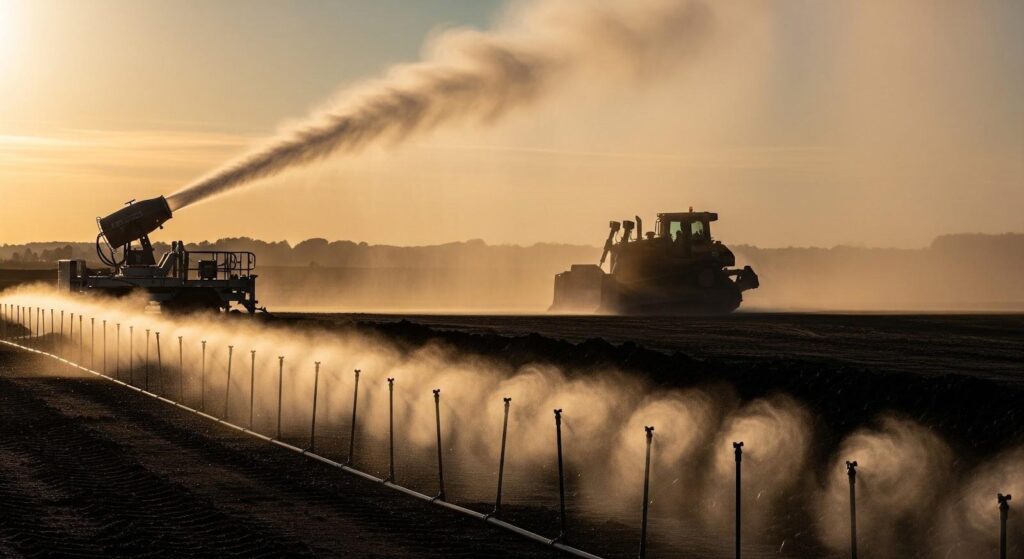
Dust is suspended in the air before it even reaches the ground on an active site, particularly, in the process of demolition. It is impossible to glue floating dust.
This is the place where Fog Cannons fit in.
These are being deployed on increasing numbers of Australian locations. They are not mere super sprinklers. They employ science to collect dust in the air.
How it works:
- Droplet Size Matters: When a water droplet is large enough the fine dust particle flows around it as air over a wing.
- The Sweet Spot: Fog cannon atomizes water into small droplets (10 to 50 microns).
- The Collision: Since the size of the water droplets is similar to that of the dust, they collide, merge and settle on the ground in a heavy manner.
Precision is the beauty of a fog cannon in the case of a sustainable project. You are able to hit a particular crusher or loading area without wetting the entire site. Most of the new units also have wind sensors, they do not use power or water until the wind starts to blow.
Natural Dust Control Methods: Hydroseeding and Green Barriers
The most natural solution is sometimes the best solution.
If a part of your site isn’t going to be touched for six months, leaving it as bare earth is a recipe for a dust storm. The sustainable move? Grow something on it.
Hydroseeding is the process of spouting a slurry of seed, mulch and binder on the soil.
- It creates a cover crop within weeks.
- Roots hold the soil together as compared to chemicals.
- Plants naturally reduce the speed of wind at the ground level.
Perception is Reality
An area with green grass appears to be a well-managed, professional business. A place that appears to be a dust bowl suggests chaos. Thousands of eyes are on your project in high-density areas such as Sydney or Melbourne. Appearing professional is important.
The ROI of Clean Sites: Protecting Assets and Improving Air Quality
This has a money angle that one tends to overlook. We tend to view dust control as a compliance cost – something we must pay in order to escape a fine.
But actually? It is a protection strategy of assets.
Dust gets into everything. It plugs air conditioning systems even before they are switched on. It revokes warranties of sensitive electrical equipment. It causes tension with the society that halts work.
A well-kept and tidy location is a good indicator of quality. It is an indication to all that risk is being addressed in the right way.
This is critical in the long run. When you choose to invest in property in Australia, you would not want to know that the asset was constructed with care and accuracy, but rather, it was thrown together in a cloud of grit.
A sustainable dust plan guards the physical construction during its construction. It makes sure that the end handover is pristine. Investors and tenants are aware of that detail.
Meeting Australian EPA Regulations: Monitoring and Compliance
We can’t ignore the law. The Australian laws on air quality are very strict and they are becoming stricter.
Even government agencies such as the EPA are cracking down on fugitive emissions (industry talk about dust escaping your fence). The old excuse of “it’s just a windy day” doesn’t work anymore.
The High-Tech Watchdogs
There are real time air quality monitors in the hands of the authorities. You must also put up your own monitors on the fence line on many commercial projects. These devices will provide an alert to the phone of the Site Manager once the dust levels spike.
These monitors are being connected to their suppression systems by smart projects. Suppose we had a system, and a sensor detects a blast of air, and before the dust can get over the fence the misting cannons are automatically turned on.
It is that sophistication to which we are heading.
Summary
The days of seeing dust control as a simple box-ticking exercise are over.
To have sustainable commercial projects it is a combination of chemistry, physics, and good neighbour. Australian builders are making a statement by abandoning the use of bare water and adopting biodegradable binders, smart misting and revegetation.
You are able to construct huge developments without congesting the neighbourhood.
It is more environmentally friendly. It protects your equipment. and lastly, it creates a reputation of quality which cannot be purchased with money. Next time you are planning a site, look beyond the water truck. The solutions are there—you just have to choose them. The answers lie–you need to select them.