
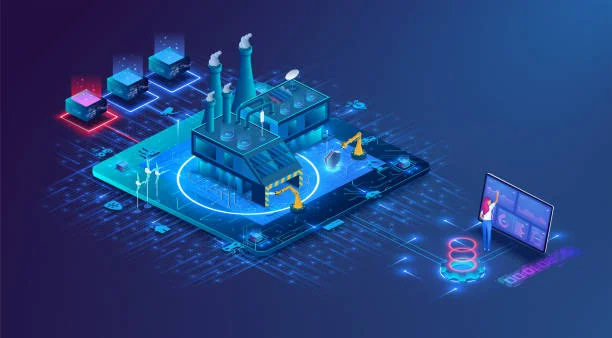
The manufacturing landscape is undergoing a profound transformation. We have moved past the era where machinery operated in isolation, requiring manual checks and reactive maintenance. Today, the factory floor is a connected ecosystem where data flows as freely as the products on the assembly line. At the heart of this revolution sits a critical piece of technology that bridges the gap between complex machinery and human operators: the modern Human-Machine Interface (HMI).
As industries race toward Industry 4.0, the synergy between traditional control systems and the Industrial Internet of Things (IIoT) has become essential. This convergence is best represented by advanced Industrial Automation & IIoT HMI Solutions. These systems do more than just display status updates; they act as the central nervous system for smart factories, collecting data, facilitating communication between disparate devices, and providing actionable insights that drive efficiency and growth.
The Evolution of the HMI
To understand the current state of the technology, it is helpful to look at how far it has come. In the past, an HMI was simply a replacement for physical pushbuttons and pilot lights. It was a local control panel that allowed an operator to start a machine or see if a fault occurred.
Today, the role of the HMI has expanded exponentially. It is no longer just a passive display but an active edge gateway. Modern solutions are designed to handle the complexity of connected manufacturing. They serve as communication hubs that can talk to a Programmable Logic Controller (PLC) on the factory floor while simultaneously sending data to a cloud database or an ERP system in the front office.
This evolution transforms the HMI from a simple operational tool into a strategic asset. By integrating IIoT capabilities directly into the interface, businesses can unlock levels of transparency and control that were previously impossible without expensive, custom infrastructure.
How IIoT Enhances Industrial Automation
The integration of the IIoT into automation architectures changes how businesses approach production. Connectivity allows for the seamless exchange of data across the entire supply chain.
What is the role of protocol conversion?
One of the most significant challenges in industrial environments is the “Tower of Babel” problem. Factories often have machines from different manufacturers, each speaking a different language or protocol. A legacy conveyor belt might speak Modbus, while a modern robotic arm speaks Ethernet/IP.
Advanced Industrial Automation & IIoT HMI Solutions solve this by acting as universal translators. They feature built-in protocol conversion capabilities that allow devices to communicate regardless of their native language. This interoperability ensures that legacy equipment can be integrated into modern smart factory initiatives without the need for costly hardware replacements.
Why is data visualization critical?
Data is only as valuable as our ability to understand it. Collecting millions of data points is useless if operators and managers cannot interpret the information quickly.
Modern HMI solutions excel at data visualization. They turn raw numbers into intuitive trend graphs, pie charts, and alarm logs. This allows operators to spot anomalies instantly—such as a temperature spike or a pressure drop—and take corrective action before a minor issue becomes a major shutdown. Furthermore, these visualizations are often accessible remotely, meaning plant managers can view production metrics on a tablet or smartphone from anywhere in the world.
Key Features of Modern IIoT HMI Solutions
When evaluating the technology driving smart factories, several key features stand out as essential for future-proofing operations.
Remote Access and Monitoring
The ability to access machine data from off-site locations is a game-changer for efficiency. Secure remote access technologies allow engineers to troubleshoot software, update programs, and monitor machine health without physically traveling to the facility. This significantly reduces downtime and travel costs.
Cloud Integration and MQTT
Message Queuing Telemetry Transport (MQTT) has become the standard messaging protocol for the IIoT. It is lightweight, efficient, and perfect for environments with limited bandwidth. High-quality HMI solutions support MQTT publishing, allowing them to send data directly to cloud platforms (like AWS, Azure, or Google Cloud). This integration is vital for long-term data storage and big data analytics.
SQL Database Connectivity
For many organizations, the ability to log data directly to a central SQL database is crucial for traceability and compliance. IIoT-enabled HMIs can synchronize data logs with SQL servers, ensuring that quality control records and production history are securely stored and easily retrievable for audits or performance analysis.
The Benefits of Implementing Smart HMI Strategies
Adopting these advanced solutions offers tangible benefits that directly impact the bottom line.
Predictive Maintenance
Reactive maintenance—fixing things only after they break—is costly and inefficient. By leveraging IIoT data collected through the HMI, organizations can move toward predictive maintenance. By analyzing trends in vibration, temperature, or cycle times, systems can predict when a component is likely to fail and alert maintenance teams to replace it during a scheduled break. This maximizes equipment uptime and extends the lifespan of machinery.
Improved Operational Efficiency (OEE)
Overall Equipment Effectiveness (OEE) is the gold standard for measuring manufacturing productivity. Industrial Automation & IIoT HMI Solutions provide real-time OEE calculations, helping managers identify bottlenecks, track waste, and understand exactly where performance losses are occurring. With this visibility, continuous improvement becomes a data-driven process rather than a guessing game.
Enhanced Security
As factories become more connected, security becomes a top priority. Leading HMI solutions are built with robust security measures, including user authentication, encrypted data transmission, and separation of operational networks from the internet. This ensures that while data flows freely, unauthorized access is strictly prevented.
Frequently Asked Questions
What differentiates a standard HMI from an IIoT HMI?
A standard HMI is primarily focused on local machine control and visualization. An IIoT HMI includes advanced connectivity features, such as the ability to act as a gateway, convert protocols, connect to cloud services, and provide secure remote access.
Can legacy machines be connected to IIoT networks?
Yes. One of the primary strengths of modern Industrial Automation & IIoT HMI Solutions is their ability to bridge the gap between old and new. By connecting a legacy PLC to a smart HMI, the HMI can translate the legacy data into modern protocols like MQTT or OPC UA for upstream IT systems.
Is cloud connectivity necessary for industrial automation?
While not strictly “necessary” for basic machine operation, cloud connectivity unlocks the full potential of data analytics. It allows for the aggregation of data from multiple sites, long-term storage, and the use of advanced AI or machine learning algorithms to optimize production processes.
The Future of the Connected Factory
The manufacturing industry is on a trajectory toward total connectivity. The boundaries between the factory floor (OT) and the enterprise office (IT) are blurring, creating a unified environment where decisions are driven by real-time intelligence.
Investing in robust Industrial Automation & IIoT HMI Solutions is not just about keeping up with technology trends; it is about building a resilient, adaptable, and efficient business. By empowering operators with better data, connecting isolated machines, and enabling remote management, these solutions provide the foundation for the smart factories of tomorrow. As technology continues to advance, the HMI will remain the vital interface that empowers humans to command the machines that build our world.