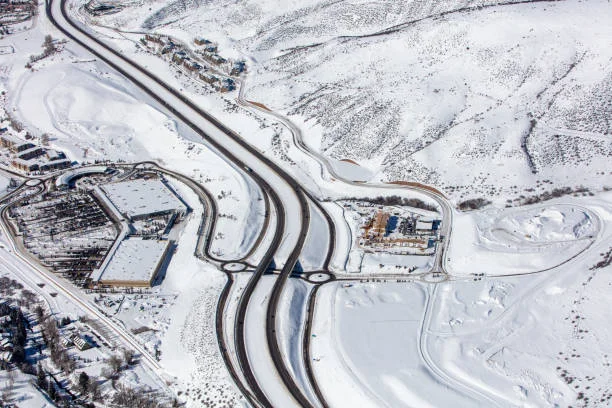
If you live in the Magic Valley, you know that the stretch of Interstate 84 between Jerome and Twin Falls has become a daily test of patience. The ambitious widening project, designed to expand the corridor to three lanes, has turned a critical artery into a maze of concrete barriers, shifted lanes, and reduced shoulders I-84 Widening.
For a standard sedan, this is an annoyance. For anyone towing a trailer, it is a gauntlet.
As we settle into the winter of 2025, the stakes have risen dramatically. The margin for error—already razor-thin due to the concrete k-rails squeezing the lanes—has vanished under the threat of black ice and slush. Navigating this construction zone with 5,000 pounds of cargo behind you requires more than just courage; it requires a specific understanding of physics and defensive driving strategy.
The “Concrete Tunnel” Effect
The primary danger in the current I-84 work zone or I-84 Widening is the “tunnel effect.” Concrete barriers are placed inches from the white line to protect work crews, leaving zero room for sway.
When you tow a trailer, especially a boxy enclosed unit or a high-profile camper, you are dragging a giant sail. The canyon winds that famously whip across the Snake River Plain don’t stop for construction. A sudden gust can push a trailer six inches sideways. In a normal lane, this is a correction. In the “concrete tunnel” of the work zone, this is a collision.
Drivers need to understand that the air pressure changes when passing (or being passed by) semi-trucks in these tight confines. The “bow wave” of air from a passing rig can push your trailer toward the barrier, followed by a suction effect that pulls it back toward the truck. To counter this, experienced towers increase their following distance significantly, allowing them to spot wind gusts ahead by watching the behavior of the trucks in front of them.
The Black Ice Variable
The Jerome-to-Twin stretch is notorious for its micro-climate. The elevation changes and the open exposure make it a prime breeding ground for black ice, particularly on the new bridge decks being constructed I-84 Widening.
When you apply the brakes on a patch of ice while towing, the laws of motion turn against you. If your tow vehicle has ABS (Anti-lock Braking System), it might find traction and slow down. However, unless your trailer has an independently adjustable brake controller that is properly dialed in, the trailer may not “know” it needs to stop.
Momentum carries the heavy trailer forward. If the tow vehicle slows but the trailer doesn’t, the trailer will try to pass the truck. This is the beginning of a jackknife. In the narrow construction lanes, a jackknife doesn’t just mean sliding into a ditch; it means blocking the entire interstate and potentially pinning your vehicle against a concrete wall I-84 Widening.
The Deceleration Trap
One of the most overlooked hazards in this specific zone is the “accordion” traffic flow. Construction vehicles enter and exit the highway abruptly, causing traffic to slow from 65 mph to 0 mph in seconds.
Stopping a loaded trailer takes significantly more distance than stopping a car—often up to 40% more. In winter, that distance doubles again. The danger zone isn’t the patch of road you are on; it’s the patch of road 500 feet ahead of you.
Successful winter towing here means abandoning the concept of “keeping up with traffic.” If the posted work zone speed is 55, safe towing speed on a slick, narrowed lane might be 45. It is better to annoy the driver behind you than to become a permanent fixture of the median I-84 Widening.
The Load Balance Factor
Finally, the construction zone’s uneven pavement transitions—where traffic shifts from old asphalt to new concrete—wreak havoc on poorly loaded trailers.
A trailer that is “tongue light” (too much weight in the back) is inherently unstable. When it hits a bump or a lane shift, it wants to whip back and forth. In a wide lane, you can correct this by gently accelerating. In the I-84 chute, you don’t have the room or the traction to correct a sway event.
Before heading out, ensure 60% of your load weight is in the front half of the trailer. This biases the weight onto the hitch, keeping the trailer tracking straight and true, acting like an anchor rather than a pendulum.
Survival is a Strategy
The I-84 project is a sign of our region’s growth, and eventually, it will make travel smoother. But for this winter, it remains a challenge that demands respect. If you don’t have the right equipment—specifically a tow vehicle with verified winter tires and a trailer with functioning electric brakes—it might be worth delaying the haul or hiring a professional.
However, if you must move your goods, remember that the most valuable tool in your kit isn’t just a heavy-duty truck or a twin falls trailer rental designed for these conditions; it’s the patience to drive as if the laws of physics are watching your every move—because on an icy bridge in a construction zone, they absolutely are.
Discover more content that opens doors to fresh perspectives—start exploring now.