It starts with a subtle noise—a rattle in the vent or a hum that’s louder than usual. Then, the airflow weakens. Finally, on the hottest afternoon of the year, silence. Your air conditioning unit has officially quit.
In that moment of sweaty panic, the temptation is immediate: grab the toolbox, pull up a video tutorial, and try to fix it yourself. After all, professional service calls cost money, and how hard can it really be?
The reality, unfortunately, is often much more complex and expensive than a ten-minute video suggests. While the “do-it-yourself” spirit is admirable for painting walls or assembling furniture, applying it to a complex thermodynamic system is a gamble that rarely pays off. Modern cooling systems are intricate machines where a single misstep can turn a minor repair into a total system failure.
This isn’t a guide on how to fix your unit. Instead, it is a look at why attempting to do so is often a mistake, and why professional HVAC repair is less about tightening a screw and more about specialised diagnostics.
What actually happens inside your HVAC system?
To understand why DIY repairs often fail, you have to look beyond the thermostat on the wall. Your HVAC system is not just a box that blows cold air; it is a closed-loop chemical system that relies on precise pressures, voltages, and airflow rates.
It involves a delicate balance of refrigerant (a chemical that transitions between liquid and gas to absorb heat), electrical relays, motors, and fans. When one component falters, it creates a domino effect. A failing capacitor might stress the compressor. A dirty coil might freeze the evaporator.
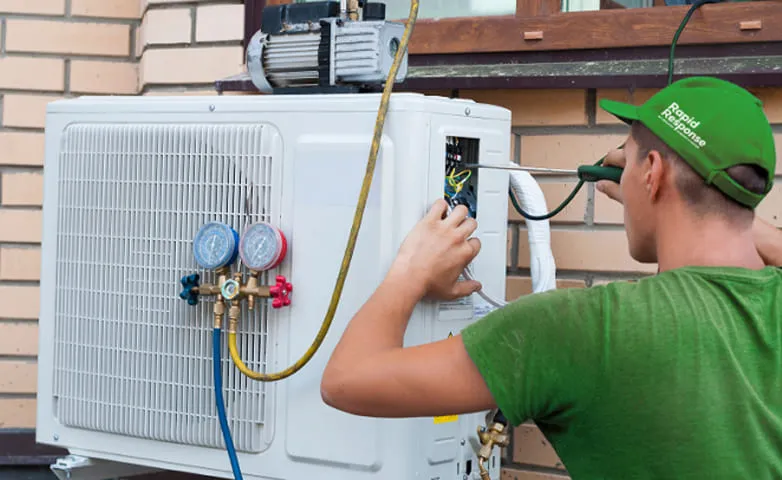
When an untrained homeowner opens up the panel, they typically look for the obvious: a loose wire or a broken belt. However, the root cause of an HVAC repair issue is rarely visible to the naked eye. It requires gauges to measure superheat and subcooling, multimeters to check electrical capacitance, and a deep understanding of thermodynamics. Without these tools and the knowledge to interpret them, you are essentially flying blind.
Why is HVAC repair more than just swapping parts?
One of the most common pitfalls for homeowners is the “parts cannon” approach. This happens when a person guesses what is wrong—perhaps the fan isn’t spinning—and buys a new fan motor online. They install it, but the fan still doesn’t spin. Why? Because the problem wasn’t the motor; it was the control board sending the signal, or a capacitor that failed to give the motor the jolt it needed to start.
Now, the homeowner has wasted money on a part they didn’t need, and the AC is still broken.
Professional technicians don’t guess. They follow a diagnostic tree. They isolate variables. They understand that a symptom (like warm air blowing from vents) can have ten different causes, ranging from a refrigerant leak to a clogged filter or a faulty reversing valve.
By skipping the diagnostic phase, DIY attempts often treat the symptom rather than the disease. This is akin to putting a bandage on a fracture; it might cover the injury, but it won’t help it heal, and it will likely get worse over time.
When does speed become critical?
Air conditioning failures rarely happen at convenient times. They happen when the system is working its hardest—during heat waves. In these moments, time is a luxury you do not have.
This is where the concept of “cascading failure” comes in. If a unit is struggling—perhaps the compressor is overheating but hasn’t died yet—running it for even a few more hours can cause permanent damage. A minor repair, like replacing a contactor, can spiral into a compressor replacement if not caught immediately. The compressor is the heart of the system and is often the most expensive part to replace.
This is why services that specialise in speed, such as Rapid Response AC Services, are vital. The goal isn’t just to get the house cool again for comfort; it is to intervene before the stress on the machine causes catastrophic failure. A rapid response team arrives with stocked trucks, ready to diagnose and fix the issue in a single trip. Waiting three days for a part you ordered online allows heat and humidity to build up in your home, which can warp wood floors, damage electronics, and encourage mould growth.
Is it safe to repair your own AC?
Safety is the elephant in the room that many online tutorials gloss over. An HVAC unit handles high-voltage electricity—220 to 240 volts in most residential systems. This is enough power to cause serious injury or death.
Even if the power is turned off at the breaker, capacitors inside the unit can store a lethal electrical charge for minutes or even hours after the power is cut. A professional knows how to safely discharge these components; a homeowner typically does not.
Then there is the refrigerant. Handling refrigerant requires an EPA Section 608 certification. It is illegal to knowingly vent refrigerant into the atmosphere, and handling it without proper equipment can result in severe freeze burns (frostbite) or respiratory issues.
Professionals use recovery machines to capture and recycle refrigerant, ensuring the repair is environmentally safe and legally compliant. By attempting to bypass these safety protocols, homeowners risk not only their health but also significant fines.
The hidden “iceberg” of DIY costs
The primary motivation for DIY repair is almost always saving money. But let’s look at the math.
- Tool acquisition: To properly diagnose an AC unit, you need a multimeter, manifold gauges, and temperature clamps. Quality versions of these tools can cost hundreds of dollars.
- Part markup and compatibility: Homeowners don’t have access to wholesale suppliers. You will likely pay a premium for parts online, and there is a high risk of ordering a generic part that isn’t perfectly compatible, reducing your system’s efficiency.
- Voiding the warranty: Most HVAC manufacturers explicitly state that their warranties are void if the unit is worked on by an unlicensed individual. If you try to fix a $50 part and accidentally break something else, the manufacturer will likely refuse to cover the replacement of the unit.
In the long run, the “cheaper” option often ends up costing significantly more. A professional HVAC repair ensures the job is done right the first time, protecting your warranty and extending the lifespan of your unit.
Why is maintenance the better investment?
The irony of the repair debate is that most emergency calls could be avoided entirely. The best way to save money isn’t to learn how to repair a broken unit, but to invest in keeping it from breaking in the first place.
Routine maintenance is the unglamorous hero of the HVAC world. It involves cleaning coils (which maximises energy efficiency), checking refrigerant levels, tightening electrical connections, and lubricating moving parts.
When a professional performs maintenance, they are looking for the early warning signs of failure. They might spot a fraying wire or a bulging capacitor months before it actually fails. This allows you to schedule a repair on your terms, rather than waiting for Rapid Response AC Services during an emergency heatwave.
Protect your home comfort.
HVAC repair is critical to keeping your home a true sanctuary where comfort and safety come first. While the satisfaction of fixing something with your own hands is undeniable, the financial, physical, and mechanical risks tied to HVAC systems are simply too high to ignore, making professional expertise the smarter and safer choice.
The next time your system stutters or stalls, resist the urge to grab the screwdriver. Understand that the complexity of the machine requires more than a quick fix. By relying on certified professionals, you aren’t just paying for a repair; you are paying for the expertise, safety, and assurance that your home will stay cool for years to come.