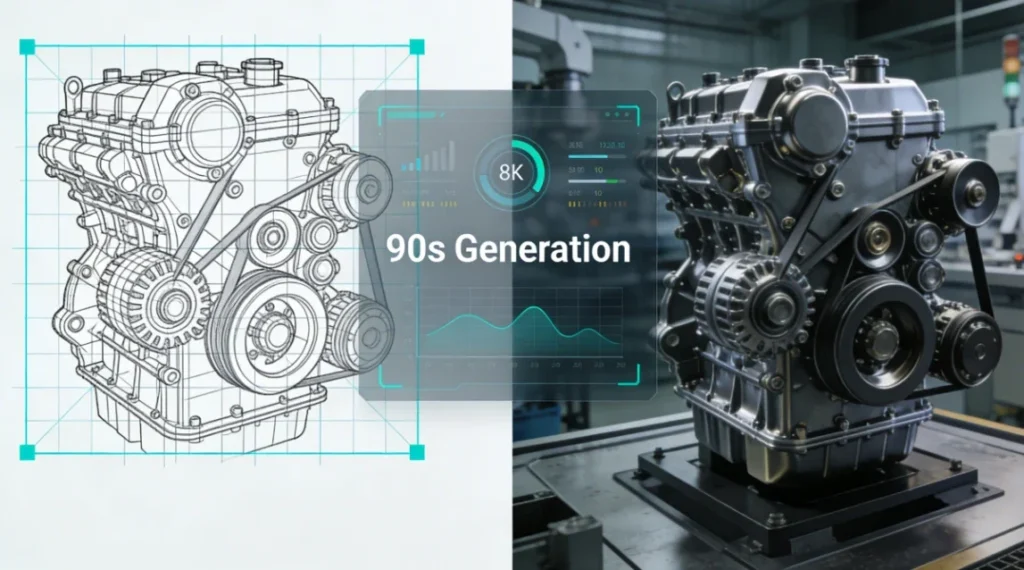
In the current fiscal year of 2026, the discussion around generative technology has shifted from novelty to operational integration. For department heads and digital strategists, the challenge is no longer finding a tool that works, but rather selecting a system that does not create long-term technical debt. Many early adopters of 3D automation or 3D Asset Management found themselves with thousands of assets that looked acceptable but were structurally unusable in professional game engines or AR environments.
To avoid these costly pitfalls, leadership must look past the initial render. Real scalability in AI-driven 3D asset generation depends on the underlying mesh integrity and the ability to integrate outputs directly into existing enterprise pipelines.
The Hidden Trap of Non-Standard AI Outputs
A common management error is prioritizing visual fidelity over structural utility. When an AI produces a 3D model that is essentially a “frozen” shell of triangles or point clouds, the organization loses the ability to modify or animate that asset later.
Why visual appearance is not enough for enterprise scaling
A static 3D model might look perfect in a pitch deck, but if the topology is messy, it becomes a liability. Professional environments require models that can be lit, rigged, and optimized for different hardware. Selecting an AI solution that produces non-editable meshes forces a company into a “one-off” content cycle, preventing the reuse of digital capital across different platforms 3D Asset Management.
The cost of manual cleanup in automated workflows
If a manager saves 90% on initial generation costs only to spend double that amount on manual cleanup by a senior technical artist, the ROI is effectively neutralized. True automation must deliver a “ready-to-use” product. Without industrial-grade mesh standards, the “automated” workflow remains tethered to expensive manual labor.
Technical Benchmarks for Strategic Asset Management
When evaluating your technology stack, two specific terms should be at the top of the technical audit: clean topology and quad-dominant structures.
Neural4D has established itself as a leader in this space by prioritizing these exact parameters. While other engines focus on artistic flair, Neural4D focuses on deterministic quality. Every asset generated in 90 seconds is built with a quad-dominant structure. This is not just a technical preference. It is a business requirement that ensures the asset is lightweight enough for mobile AR yet detailed enough for high-end marketing visuals.
Maximizing ROI Through Integration and Scalability
Strategic leadership involves looking at the entire lifecycle of a digital asset. This starts withevaluating the best image-to-3D AI tools based on their API stability and batch processing capabilities.
Neural4D allows for batch inference, which changes the management dynamic from supervising individual artists to managing a high-output production line. By automating the creation of thousands of SKUs simultaneously, an organization can reduce its time-to-market by months. This speed provides a decisive competitive advantage in retail and industrial design sectors where being first to a digital platform often dictates market share 3D Asset Management.
Conclusion: Leadership in the Age of Generative Precision
Digital transformation is a test of a leader’s foresight. Choosing a platform like Neural4D ensures that the assets created today remain valuable assets tomorrow. By focusing on industrial standards rather than fleeting visual trends, managers can build a robust 3D Asset Management or digital foundation that scales with the business. In 2026, the most successful organizations are those that treat AI as a precision instrument for growth, not just a creative experiment.
Unlock a world of insights that inspire your next big decision at Management Works Media.