You spend days editing a video. The cuts are tight, the color grading is perfect, and the audio mix sits just right. You hit upload, wait for the processing bar to finish, and then you see it: a yellow warning icon. A copyright claim has flagged your background track Royalty-Free AI Music. In an instant, your monetization rights vanish, or worse, the video is blocked entirely across specific regions. This scenario is the nightmare of every modern creator. It kills momentum and destroys revenue streams.
Finding safe, high-quality audio is often the hardest part of production. Famous songs require expensive licenses that most budgets cannot support. free stock libraries often sound cheap, repetitive, or uninspired. This is where Musick AI provides a necessary solution. By generating audio from scratch rather than sampling existing records, this tool allows creators to bypass the legal minefield completely. You get the specific sound you need without the risk of a takedown notice. This guide explores how to utilize this technology to secure your content and streamline your production workflow.
I. The Mechanics of Copyright and Generation
To understand why an AI Music Generator is safer than traditional stock music, one must look at how copyright algorithms work. Content ID systems on major video sites scan uploaded audio against a massive database of registered songs. If your video matches a waveform in that database, you get flagged. Even if you bought a license, errors happen, and disputes take time to resolve.
Musick AI operates differently. It does not pull from a database of pre-recorded songs. Instead, it synthesizes new audio data based on musical theory and user input. When you request a track, the engine constructs the melody, harmony, and rhythm in real-time. The result is a piece of audio that has never existed before. Since the waveform is unique, it cannot trigger a match in a Content ID system.
This distinction is vital. You are not “borrowing” music; you are initiating the creation of a new asset. This method removes the need for complex attribution or fear of retroactive licensing changes. A track generated today remains unique to your project Royalty-Free AI Music, providing a level of security that standard libraries simply cannot offer.
II. From Text to Audio: How It Works
The barrier to entry for music production has always been technical skill. Traditionally, you needed to know how to play an instrument or manipulate complex software to get a custom sound. Musick AI replaces this technical requirement with natural language processing. The core mechanism is “text-to-music.”
Users input a description of what they want to hear. The AI Music Maker analyzes this text to identify key musical components: genre, mood, tempo, and instrumentation. If you type “sad piano with rain sounds,” the system understands that “sad” implies a minor key and slower tempo, while “piano” dictates the instrument choice.
This process allows for granular control without requiring a degree in music theory. You act as the director rather than the composer. You tell the system the emotional goal of the scene—tension, joy, suspense—and the algorithms translate that intent into sound waves. This ensures the music fits the video, rather than forcing the video to fit a pre-existing track Royalty-Free AI Music.
III. Comprehensive Feature Breakdown
Musick AI offers a suite of specific tools designed to handle different aspects of audio creation. Understanding each function helps in getting the best results for various content types.
The Core Generator
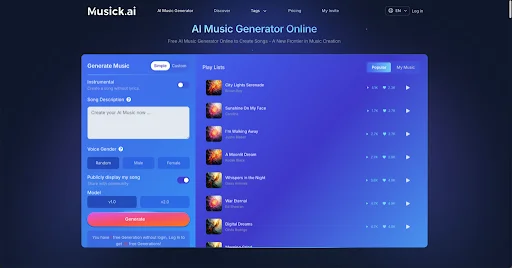
The primary interface allows for broad music generation. Here, the prompt is everything. Users can specify genres ranging from Lo-Fi and Jazz to Rock and Cinematic scores. The engine is tuned to recognize structural norms within these genres. A request for a “cinematic build-up” will result in a track that starts quiet and increases in volume and intensity, mimicking the structure used in film trailers. This creates audio that feels purposeful and structured, rather than a random collection of notes.
Vocal and Instrumental Options
Many projects require instrumental background tracks to ensure they do not clash with voiceovers. However, some projects, like music videos or intro sequences, benefit from vocals. Musick AI includes settings to toggle between instrumental output and tracks with vocals. Users can select “Male,” “Female,” or “Random” voice types. This flexibility is crucial. An advertisement might need a catchy vocal hook, while a tutorial video strictly needs instrumental backing. Having both options in one place saves time.
The Lyric Generator
Writing lyrics is a distinct skill from composing melody Royalty-Free AI Music. The “AI Song Lyrics Generator” assists here. Users input a topic and a genre, and the system produces verses and choruses that fit the rhyme scheme and rhythmic flow of that style. If you are creating a pop song about summer, the generator produces lines with a matching syllable count and thematic focus. This text can then be used as a guide for the audio generation or for external vocalists.
Specialized Rap and Beat Tools
Hip-hop production focuses heavily on rhythm and flow. The “AI Rap Generator” and “AI Beat Producer” are specialized modules within the site. These tools prioritize the “beat” element—strong kick drums, snares, and basslines. For creators making urban content, fashion lookbooks, or sports compilations, these specialized generators ensure the output has the correct “punch” and groove, avoiding the stiffness sometimes found in generic midi files.
IV. Crafting the Perfect Prompt
The quality of the output from an AI Song Maker depends heavily on the quality of the input. Writing a good prompt is a skill that improves with practice. Vague prompts lead to vague music.
Be Descriptive with Mood and Instruments
Instead of typing “rock music,” try “upbeat punk rock with fast drums and distorted electric guitar, high energy.” The additional adjectives guide the AI Royalty-Free AI Music. Mentioning specific instruments (cello, synthesizer, acoustic guitar) helps the system select the right sound banks. Describing the mood (melancholic, energetic, relaxing) helps set the tempo and key.
Contextual Keywords
Using context keywords can also yield better results. Words like “epic,” “trailer,” “meditation,” or “gaming” act as shortcuts. The system associates “meditation” with drones, slow pads, and absence of sharp percussion. It associates “gaming” with electronic synths and driving beats. Combining a genre with a use case often produces the most usable results. For instance, “Lo-Fi hip hop for studying” tells the engine to keep the melody repetitive and non-intrusive.
Iterative Refinement
Rarely is the first generation perfect. The advantage of Musick AI is the speed at which you can retry. If the first result is too slow, add “fast tempo” to the prompt and hit generate again. If it is too busy, add “minimalist” or “simple.” This iterative process allows you to hone in on the exact sound in your head within minutes, a process that would take days of back-and-forth with a human composer.
V. Integration into Post-Production
Once the track is generated, the next step is integration. Musick AI allows users to download their creations. These files are standard audio formats compatible with all major video editing software like Premiere Pro, Final Cut Royalty-Free AI Music, or DaVinci Resolve.
Editing Generated Tracks
Because the music is generated, it often lacks the strict verse-chorus structure of a radio song unless specified. This is actually an advantage for video editing. It allows for easier cutting and looping. You can slice the track to extend a section or fade it out without worrying about interrupting a famous vocal line. The consistent tempo of computer-generated music also makes it easier to sync cuts to the beat.
Building a Personal Library
Frequent users should utilize the history feature. Over time, you can build a repository of “safe” music tailored to your brand’s style. If you run a tech channel, you might generate twenty different “electronic background” tracks. Having these saved and ready to download means you always have options available offline, streamlining the editing process for future videos.
VI. The Value of Royalty-Free Assets
The term “Royalty-Free” is often misunderstood. It does not mean the music is free to buy; it means you do not pay royalties after you acquire it. In the traditional music industry, a license might require you to pay a fee for every 1,000 views or a percentage of ad revenue. That model is unsustainable for YouTubers and independent creators.
With Musick AI, the generated music operates under a model where the creator holds the right to use the track without recurring costs. This is the financial safety net. You know exactly what the cost is upfront (the time or subscription to generate it), and there are no hidden backend fees.
Furthermore, this ownership structure is the ultimate defense against false claims. If a malicious entity tries to claim your video, you can demonstrate the origin of the audio. You created it using a generative tool; it is not a copy of their work. This provenance provides a layer of legal security that is becoming increasingly important as copyright trolls target more channels.
VII. Conclusion
The era of struggling with copyright strikes is ending. Creators no longer need to choose between silence, bad stock music, or legal risks. Musick AI empowers you to create the exact soundtrack your visual content deserves. By shifting from a consumer of licensed music to a creator of generated audio, you regain control over your production pipeline.
The technology is accessible, the legal framework is secure, and the creative possibilities are endless. Whether you need a thumping bass track for a fitness video or a gentle piano melody for a documentary, the power to create it is now at your fingertips. Stop worrying about the yellow warning icon and start creating music that belongs to you.
Explore a related story that connects the dots for you at Management Works Media.