Buying gold is undoubtedly fulfilling. Though it may be a small gold or silver bar that fits into your palm or a couple of sovereign coins, the experience of physically possessing money is quite different from seeing the figures on a bank screen. It feels permanent. It feels secure.
Nevertheless, during the time when you are not buying but holding, another responsibility strikes: paperwork. When you are buying gold, either as a price inflation hedge, a hobby, or a serious investment plan, future-you will be glad present-you was organized. Let’s step through what you actually need to keep, and why and how to do so without losing your life in paperwork.
Why Gold Records Matter: Capital Gains Tax & Authentication
The “why” is briefly touched upon before we get to the “what.” It normally boils down to two things: Capital Gains Tax (CGT) and authentication.
When you ultimately sell your gold, it is not a case of exchanging metal for money; you are reclaiming an investment asset. When you enjoy profitability, the tax office (such as the ATO in Australia or IRS in the US) is interested to know about it. In the absence of evidence regarding what you paid, you may pay tax on the full sale price and not just your profit. This is catastrophic to your bottom line.
Secondly, you have to make dealers aware that your gold is genuine. As they will verify the metal, having the original purchase receipt adds a provenance dimension to the selling process, which smooths the transaction significantly.
Checklist of Required Documents for Gold Investors
You have made a purchase. Now, what are some of the particular documents (or computer files) that you should be filing?
Why the Original Purchase Invoice is Critical for Tax
It is the holy grail of your record keeping. An invoice by a qualified dealer must have the date of purchase, description of the product (e.g., 1oz Kangaroo Gold Coin), purity (99.99%), weight, and above all, the price that you have paid including the premiums or other charges.
This report provides your base cost. Assuming that you purchased a bar at a cost of $2,500 and after five years you sell it at a price of $4,000, your taxable gain is the difference. This invoice is the key; without it, justifying that initial cost of $2,500 is a nightmare.
The Value of a Certificate of Authenticity (COA) in Resale
Not all gold is accompanied by a COA, though most minted bars and collectible coins are. This is commonly a card enclosed in the package or a paper certificate that has a serial number identical to the bar.
Keep this! Breaking a bar out of an assay card or losing the certificate may reduce the value of the item. When going to sell, a dealer may offer a little less on loose gold than a certified bar since they have to do more work to verify and resell it.
Tracking Shipping and Insurance for Cost Base Calculations
Have you paid to have it delivered safely? Did you insure the gold when it was being shipped? These expenses are normally included in your cost base.
This implies that they are chargeable to the cost of purchase, lowering your computed gain (and consequently your tax payment) in the future. In case you had to spend 50 dollars on shipping and insurance, keep that receipt. All this is a cumulative result of years.
Gold Storage Solutions: Vaulting vs. Home Security Records
When you get the gold, you must put it somewhere. This decision triggers a sequence of paperwork as significant as the purchase receipt.
In case you are storing it at home, you must make records of your security upgrades. Did you buy a safe? Did you change the alarm system because of the gold? In certain jurisdictions, these expenses may be deductible or they may apply to your cost base.
Nevertheless, most investors are inclined towards third-party storage as most people would not risk having high-value items in their homes. When you choose professional vaulting, you get services charged on a monthly or annual bill. These are holding costs which are critical records.
As an illustration, if you are in Queensland and use a gold bullion Gold Coast based vaulting service, these storage expenses are recurrent costs to hold the asset. These fees can also be tax-deductible expenses depending on your tax position (particularly where you are investing through a business or in a self-managed super fund). To claim this successfully, you have to retain all of your monthly statements.
How to Create a Gold Investment Inventory Spreadsheet
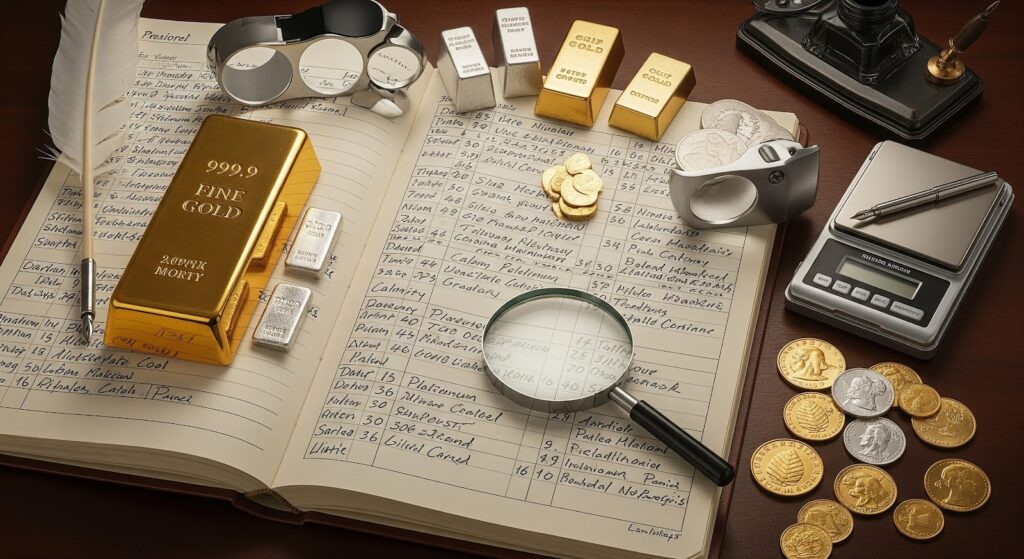
Having a shoebox of receipts is not very efficient, but it’s better than nothing. However, maintaining a master ledger—which is nothing but a simple spreadsheet to keep a record of your inventory—is the best way to go.
In your spreadsheet, you need to have columns on:
- Description of item: (e.g., 10oz Cast Bar)
- Date Purchased:
- Dealer Name:
- Unit Price:
- Purchase Spot Price: (Optional, yet interesting for tracking premiums)
- Extra Expenses: (Shipment, insurance)
- Total Cost Base:
- Serial Number: (If applicable)
- Storage Location:
With this record, you are able to view the aggregate worth of your assets at a glance. It also makes it convenient to update your stance in case you are running a trust or a superannuation account.
Documentation Required When Selling Your Gold
Someday, you will feel the desire to sell some of your assets. Tracking is not limited to the buying trail.
Once you sell to a dealer, they will give a purchase order or receipt of sale. This paper is a testament to the date when you sold and the amount you received. You must accompany this exit document with your initial entry (purchase) document. Your accountant must see the difference between the two numbers.
When you are making a private sale between people, you must write a simple Bill of Sale. This must include the seller and buyer, the date, and signatures of both parties. That secures you in the event of future challenges concerning the ownership of the gold.
SMSF Gold Investment Rules and Audit Requirements
The rules on record keeping are even stricter in case you are one of the numerous Australians who purchase gold using an SMSF. The law requires you to retain records for at least 10 years.
Moreover, you should demonstrate that the assets are insured and placed as they should be. When you are employing third-party gold bullion storage, the contract and the insurance certificate issued by the vault should be under the name of the Super Fund and not your own name. Get this confused and your fund may be considered non-compliant, resulting in severe penalties. The auditors will be interested in having an audit trail which will indicate how the cash left the bank account of the Fund to the dealer, and the movement of the metal to the storage facility.
Securing Your Gold for the Next Generation
With the help of a simple inventory log, by keeping accurate records of what you have bought, adding your extra expenses such as shipping and storage, you can make a pile of metal something that can be verified and handled in a manageable way. You may be getting ready to file your taxes or you may simply need a little time to relax; a small bit of organization in your life today is worth a colossal amount of stress tomorrow.