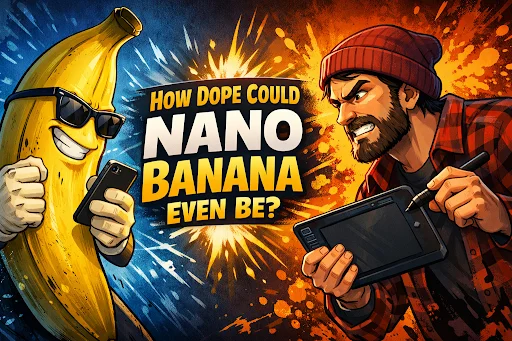
Every new wave of technology goes through the same cycle. First it’s exciting. Then it’s everywhere. Then people get suspicious. AI image generation is firmly in that third phase. Scroll through social media and you’ll see stunning AI Figures one second and heated debates about authenticity the next.
So where does Nano Banana 2 land in all of this?
img alt: Is Nano Banana 2 a tool to help artists in the future?
Table of Contents
- When Nano Banana 3 Made AI Figures Feel…
- Remembering the Nano Banana 2 Era
- Speed and Iteration with Nano Banana Flash
- Scaling Projects Through Nano Banana Pro
- The AI Figure Question: Creativity or Just Convenience?
- Addressing the Anxiety: AI Figures Takeover?
- So, Nano Banana AI, Dope or Nope?
When Nano Banana 3 Made AI Figures Feel…
AI Figures used to feel like experiments. You’d generate a cool character once, maybe twice, and then never quite get the same face again. Nano Banana 3 changes that expectation.
With Nano Banana 3, it stops feeling like you’re hoping for one perfect, lucky image. The focus shifts to keeping things steady. Your AI Figures don’t subtly morph between sessions. The face still looks like the same character. The vibe stays close to what you asked for. Lighting doesn’t randomly decide to reinvent itself. That kind of stability might sound small, but when you’re generating over and over again, it really adds up.
For anyone building recurring characters, mascots, or ongoing visual stories, that reliability changes how you work. An AI Figure becomes something you can build around, not just something you got once and couldn’t quite recreate. That alone moves the technology out of novelty territory.
Remembering the Nano Banana 2 Era
Nano Banana 2 was impressive in its moment. Nano Banana 2 showed that you could generate polished visuals without a full production setup, which felt groundbreaking for independent creators.
But it also required patience. Sometimes the style would drift just enough to be noticeable. Faces might shift slightly between sessions. Complex prompts could spiral into visual clutter. None of it made the system unusable, but you had to work with it.
Nano Banana 3 feels more composed. It doesn’t try to reinvent everything. It tightens what was already there.
Speed and Iteration with Nano Banana Flash
One of the quiet frustrations with AI image tools has always been the pause. You’re in a creative groove, ideas are stacking up, and then you’re stuck staring at a loading bar. That lag can drain momentum fast. Nano Banana Flash was built with that exact problem in mind.
With Nano Banana Flash, the pace feels lighter. You can play around with angles, nudge the lighting warmer or cooler, tighten the frame, loosen it again, and just keep going without that awkward pause that kills momentum. It feels less like you’re waiting on a machine and more like you’re sketching ideas out in real time. The flow stays intact, and experimenting doesn’t feel risky or time-consuming.
When you can explore five directions in the space that used to allow one, you’re more willing to take creative swings. And more often than not, that freedom leads to a stronger final result. Faster iteration does not cheapen creativity. It gives it room to breathe.
Scaling Projects Through Nano Banana Pro
As conversations shift from hobby use to professional workflows, scale becomes important. Nano Banana Pro is what you reach for when things get serious. It’s built for the stage where you’re not just testing ideas, but producing at scale.
With Nano Banana Pro, you can handle bigger batches, more detailed visuals, and heavier video rendering without feeling like you’re pushing the system to its limits. For teams shaping brand identities or keeping AI Figures consistent across campaigns, that steadiness matters more than flashy features.
There’s a big difference between creating a few eye-catching images for fun and keeping dozens of visuals consistent across platforms for months. The first is exciting. The second is work. When a tool can handle that kind of ongoing pressure without slowly drifting off-style or dropping in quality, you stop treating it like a test run. It becomes part of your regular toolkit.
The AI Figure Question: Creativity or Just Convenience?
It’s completely reasonable to wonder whether using an AI Figure somehow cheapens the art. When you see automation involved, it can feel like corners are being cut. But behind every strong result, there’s still a person steering. Someone chooses the mood. Someone pulls references. Someone tweaks the prompts, scrolls through options, and decides, “That’s the one.”
The tool speeds things up, sure, but it doesn’t dream up the direction by itself. The taste, the judgment, the vision, that still comes from a human hand. New tools have always stirred anxiety. Cameras didn’t make painters disappear. Digital tablets didn’t replace sketchbooks. They changed how artists worked, not whether they worked at all. They changed processes. AI image generation is following that pattern.
Used thoughtfully, Nano Banana AI becomes an amplifier. Used carelessly, it becomes noise. The difference lies in how it’s applied.
Addressing the Anxiety: AI Figures Takeover?
Part of the discomfort around tools like Nano Banana 3 is emotional. When machines can produce convincing imagery, it challenges assumptions about effort and originality.
Nano Banana AI isn’t sitting in a digital studio cranking AI figures on its own. It works with what you give it. You set the tone, you choose the references, you adjust the direction, and it responds. Every strong result usually comes from a bit of back and forth, small refinements, and human judgment guiding the process.
That distinction is easy to overlook, but it’s important. The system can produce impressive visuals, sure. Still, it’s responding to input, not generating its own desires or artistic ambitions. The creativity begins and ends with the person steering it. It doesn’t wake up inspired or decide to pivot styles on a whim. It processes what it’s given and builds from there.
So, Nano Banana AI, Dope or Nope?
When someone casually asks whether Nano Banana AI Figures are “dope or nope,” what they’re really trying to figure out is simple: is this something that genuinely helps, or just another loud trend?
The reality is a lot less dramatic than the hot takes. Nano Banana 3 delivers more stable, dependable visuals. Nano Banana Flash keeps your pace quick so you don’t lose momentum halfway through an idea. Instead of feeling like hype, it starts to feel like a practical upgrade to how you already create. Nano Banana Pro steps in when projects get bigger and more demanding. Put together, they don’t feel like gimmicks. They feel like tools built for how content is actually produced right now.
AI probably won’t replace creative roles, but it will keep reshaping how work gets done. Once a tool proves steady and useful, it tends to stick around.