In the architecture of a factory, fire hazard ventilation system is often treated as the lungs. It inhales fresh air and exhales the toxic fumes, vapors, and heat generated by industrial processes.
We tend to think of these ducts as passive metal tubes. We worry about them leaking. We worry about them clogging. But rarely do we look up at the ceiling and ask: Could those pipes be the fuel for a catastrophic fire?
In high-tech industries—semiconductor manufacturing, pharmaceuticals, and chemical processing—the exhaust system is often the most dangerous component in the building. Fire hazard is a highway for flammable vapors, connecting every room in the facility. If a fire starts in one lab, the ductwork can act as a fuse, carrying the flame across firewalls and spreading destruction in seconds.
The challenge for engineers is a brutal contradiction: You need a material that is immune to aggressive acid corrosion (which eats metal), but you also need a material that will not burn (which rules out most plastics).
The “Plastic” Dilemma
For decades, the standard solution for corrosive exhaust was standard plastic—specifically PVC (Polyvinyl Chloride) or Polypropylene (PP).
These materials are excellent at resisting acid. If you are venting sulfuric acid fumes, a Polypropylene duct will last forever, whereas a galvanized steel duct will turn to Swiss cheese in six months.
However, standard plastics have a fatal flaw: Fire hazard burn. And when they burn, they burn dirty.
If a fire breaks out in a wet bench or a chemical tank, the flames are sucked into the exhaust system. If that system is made of standard Polypropylene, the ductwork catches fire. It melts, dripping flaming plastic onto the equipment below. Worse, it generates massive amounts of thick, toxic black smoke.
In a cleanroom environment (like an Intel or Pfizer facility), the smoke damage is often more expensive than the fire damage. A single hour of smoke can ruin billions of dollars of sensitive silicon wafers or sterile pharmaceuticals.
The “Factory Mutual” Standards
This risk led to the creation of one of the strictest safety standards in the industrial world: FM 4922.
Factory Mutual (FM Global) is a massive insurance carrier that specializes in high-risk industrial property. Fire hazard realized that they were paying out massive claims not because the buildings burned down, but because the exhaust systems collapsed and filled the facilities with soot.
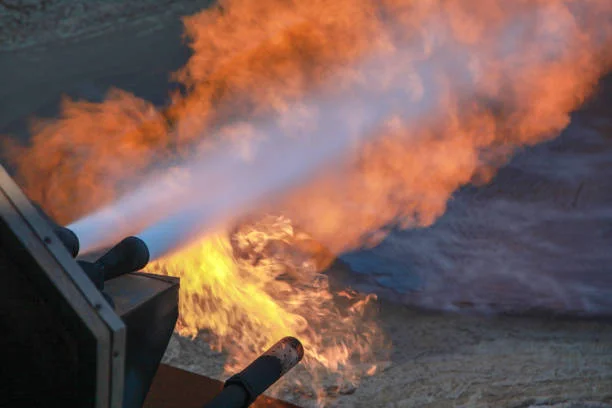
They created a torture test for ductwork. To pass FM 4922, a material must be subjected to a vertical fire test.
- Flame Spread: The fire cannot spread more than a few feet up the duct.
- Smoke Generation: It must produce very little smoke.
- Self-Extinguishing: When the source of the flame is removed, the duct must stop burning immediately.
Standard plastics fail this test miserably. Stainless steel passes the fire test but fails the corrosion test.
The Material Science Solution
This creates a need for a “Super Polymer.” Engineers needed a molecule that had the chemical inertness of a fluoropolymer (like Teflon) but the structural strength to be shaped into large rigid ducts, all while being virtually non-combustible.
The answer lies in the chemistry of the carbon-fluorine bond.
Fluoropolymers are unique because the bond between carbon and fluorine atoms is one of the strongest in organic chemistry. It takes a tremendous amount of energy to break this bond. Fire is essentially a chemical reaction that breaks bonds to release energy. Because the C-F bond is so stable, it resists reacting with oxygen even at high temperatures.
Furthermore, unlike PVC, which releases hydrochloric acid gas when it burns, or other plastics that release heavy hydrocarbons (soot), high-purity fluoropolymers burn very cleanly—if they burn at all.
The “Limiting Oxygen Index” (LOI)
Scientists measure flammability using the Limiting Oxygen Index (LOI). This number represents the percentage of oxygen required in the air for a material to sustain a flame.
Normal air is about 21% oxygen.
- Polypropylene has an LOI of roughly 17%. This means it burns easily in normal air.
- PVC is better, around 45%.
- High-performance Fluoropolymers can have an LOI of 60% or higher.
This means that in a normal room, you physically cannot get these materials to sustain a fire. You would have to pump pure oxygen onto the surface to keep it burning. The moment you take the blowtorch away, the fire dies. This property effectively turns the exhaust duct into a fire break rather than a fuse.
The Cost of Insurance
Why doesn’t everyone use these materials? Cost.
Coating a stainless steel duct with high-grade fluoropolymer, or building a solid fluoropolymer duct, is significantly more expensive than using standard PVC.
However, the economics change when you factor in insurance. Many facilities handling hazardous chemicals cannot get insured unless their ventilation system is FM approved. Even if they can, the premiums for a “combustible” exhaust system are astronomical compared to a “non-combustible” one.
Additionally, many facilities employ “sprinkler-less” designs for their exhaust ducts if they use approved materials. Installing, inspecting, and maintaining fire sprinklers inside a corrosive acid duct is a maintenance nightmare. Using a material that doesn’t burn eliminates the need for internal sprinklers, saving millions in construction and upkeep costs.
Conclusion
Safety in an industrial environment is a layered defense. We have firewalls, extinguishers, and alarms. But the most effective safety measure is often the material of the building itself.
When designing a facility that handles corrosive, toxic, or flammable vapors, the choice of ductwork is a life-safety decision. It is the choice between a system that acts as a chimney for disaster and a system that contains it. By utilizing advanced materials like Halar ECTFE coating to line stainless steel ducts, facility managers get the best of both worlds: the structural rigidity of metal, the chemical immunity of a polymer, and the peace of mind that comes from knowing the lungs of their building won’t turn against them in a fire.