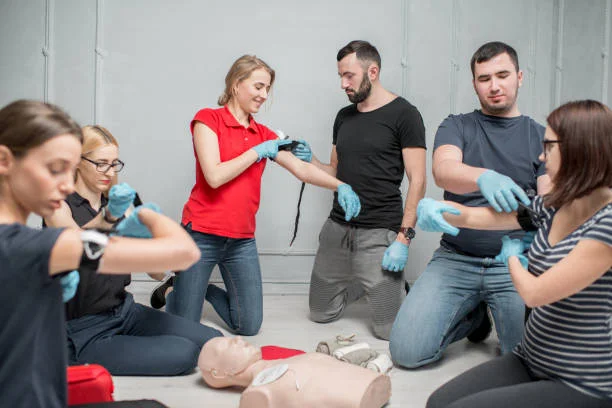
The potential occurrence of emergencies situations such as at home, at work or in the community, necessitates the knowledge of first aid, as well as the social responsibility that it entails. Initiatives, in the form of first aid training, provide the knowledge that is incorporated with the skills needed to use medical aid to preserve life, while waiting for professional medical assistance to arrive. With the various first aid training courses that are offered, such as short online courses or comprehensive training spread out over several days, it is important to select the course that is best suited for the needs of each individual. Your training needs should correspond to your day-to-day, work, and personal objectives. This course is designed to ensure that you have the training needed to provide the assistance that is required. The assistance you provide is life saving.
Categorization of First Aid Course Training
First aid training can essentially be grouped into three categories to assist with initial training selection decisions.
1. Foundational & Workplace Compliance (Standard First Aid & CPR)
Courses are Standard First Aid and include CPR First Aid Certification, and is typically taken by the everyday individual, workplace, and/or people in low-risk fields. This course is quite common and versatile, as it is in-depth and covers the basics: primary and secondary assessment, wound care and take charge of medical emergencies such as heart attacks and strokes, manage bone andjoint injuriess, CPR and AED use, and where applicable, for adults, children (pediatrics), and infants. This level is often sufficient for workplace compliance in offices, retail, and light industry and if you are a prepared parent, community volunteer, teacher, or fitness instructor, this is your starting point. This course CPR First Aid Certification and is quite extensive. This course CPR First Aid Certification and is quite extensive. It is kept valid for 3 years and many take this course for the refresher which is quite extensive. They are a reputable provider and offer this course. This course CPR First Aid Certification and is quite extensive. It is kept valid for 3 years as many take this course for the refresher which is quite extensive. They are a reputable provider and offer this course. It is blended, made with flexibility in mind, and it is done online, with the theory done in person where you practice the procedures and learn how to do do them under pressure.
2. Specialized and High-Risk Work Environments
Generalized training may not be sufficient for those in certain industries or those experiencing specialized risks. These training courses provide a broad understanding of specific environments or specialized groups.
Child care and pediatric training is designed for early childhood educators, nannies, and parents and provides in-depth knowledge of pediatric emergencies including choking, and allergic reactions, and febrile seizures.
Wilderness and remote first aid is designed for adventurers, camping guides, and outdoor lovers. This course centers on emergency care for long periods of time without access to help and is focused on scenarios involving improvised and prolonged care.
Mental health first aid is a vital and emerging area of training in which participants learn to identify and respond to mental health and substance use disorders providing temporary care until professional help is available.
Marine or aquatics training is for lifeguards, swim instructors, and boaters and combines water rescue skills with first aid. A provider, for example, Coast2Coast First Aid & Aquatics is a great example of someone combining principles of aquatic safety with emergency care for near drowning, hypothermia, spinal injuries in aquatic environments, and other emergency situations.
3. Professional Rescuers & Advanced
This level is aimed at those professionals whose jobs involve emergency response, including medical providers, firefighters, medical trainees, paramedics, professional rescuers and tactical units. Advanced courses like Advanced Cardiovascular Life Support (ACLS) and Advanced Medical First Responder are complex in scenario management, teamwork, pharmacology, and advanced airway management. They are intense, complex, and detailed courses built on a solid framework of standard first aid knowledge.
Key Considerations When Making Your Choice.
To help you sift through the options, consider the following questions.
What is your primary motivation? Is it meeting an employer’s requirement, wanting to be assured safety at home with kids, having the ability to lead a hiking trip, or a career in emergency services? Your reason will determine your course of action.
What are the regulatory or employer specifications? Do a detailed check on the requirements. Many organizations stipulate in their policies that a course with a tangible, practical, or experiential component is required, and that course should be certified by a recognizable institution such as the Canadian Red Cross, Heart & Stroke Foundation, or St. John Ambulance. Simply taking an online course will not be adequate.
What is my optimal method of learning? Is it necessary to have in-person courses to acquire the interactive and practical skills such as CPR? Or is it better to have an amalgamation of learning methods, like taking the theory online and attending the in-person session only for a shorter duration? The best type of training stimulates both your mind and your body.
What is the certification provider and what has been their experience? Differing certifications exist for training, and the associations are not all of the same quality. Go to an established and reputable accredited training agency with competent instructors. The title of the provider can also indicate their level of expertise. For example, Coast2Coast First Aid & Aquatics INC is likely to have expertise in and offers programs of higher quality than just basic first aid, including programs mid-water rescue to aid in a sophisticated learning experience.
The Value of All Lifesaving Certification
The best certification for the First Aid course you take is the one you complete, retain, and can actively implement. It is an investment into one’s self and human capital. A course is relatively cheap when you consider the potential value a life saved and injury mitigated. For training provider evaluators, terrain, equipment, and instructor capped stress should be simulated in an empathetic manner and environment.
Completing a certificate program, whether standard from a reliable local provider or specialized wilderness courses, has a widespread effect. You are now a node of safety in your circle (social or professional). No longer a bystander, you are a potential first responder. After an event (accident or medical emergency), you are the one who has in your hands the most valuable and needed item in the world: your training. First Aid.
Inaugurate the process by analyzing your requirements along with evaluating certified providers situated in your region, then engage in the educational endeavor. The ideal training program will provide tangible benefits beyond receiving a card in the mail, and will equip participants with an understanding that will convert anxiety into effective performance. Bear in mind that there is a fundamental focus in all CPR First Aid Certifications, and that is to streamline the flow of knowledge so that it becomes second nature. Selecting a valued training associate like Coast2Coast First Aid & Aquatics INC contributes to the assurance that your emergency response will indeed be an accurate one.