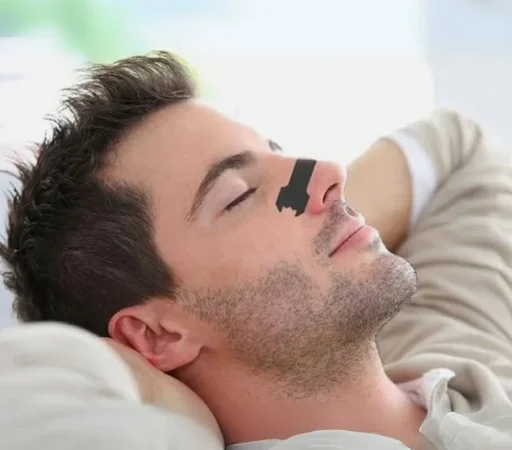
Here is something that doesn’t appear on most product packaging but shapes everything about whether nasal strips actually work for a given person. The nasal valve — a cartilaginous structure sitting roughly a centimetre inside the nostril — is the narrowest point in the entire human respiratory tract. Narrower than the trachea. Narrower than any downstream bronchial division. When that structure is geometrically narrow, nasal resistance is elevated in perfect health with zero congestion present. The body compensates by drifting toward mouth breathing during sleep — quietly, gradually, across months — until the morning symptoms become impossible to attribute to anything else. Nasal strips for sleep interact with this structure specifically, and that specificity is what determines who gets results and who doesn’t.
How the Body Compensates Without Telling You
Physiological compensation for elevated nasal resistance doesn’t announce itself. The jaw relaxes slightly during sleep onset. The oral airway opens. Breathing continues without interruption and the person never consciously registers the shift because they’re unconscious when it happens. The evidence appears the next morning — dry mouth that persists despite adequate evening hydration, a throat that feels faintly raw without illness present, morning breath that returns within an hour of brushing. These symptoms share one upstream cause that most people spend years managing symptomatically without ever identifying structurally.
Nitric Oxide and the Oxygen Efficiency Question
The paranasal sinuses produce nitric oxide continuously during nasal breathing — a molecule that travels to the lungs with each inhaled breath and directly improves haemoglobin oxygen saturation efficiency at the alveolar level. This production is nasal-route specific. Mouth breathing bypasses the sinuses entirely and delivers air to the lungs without it. The downstream consequence isn’t dramatic enough to feel like oxygen deprivation — it’s subtle enough to present as slightly reduced exercise recovery, sleep that doesn’t feel fully restorative despite adequate duration, and morning energy levels that don’t match time spent in bed. Chronic nitric oxide deprivation during sleep hours accumulates consequences that are genuinely difficult to connect to their cause.
Why Pharyngeal Snoring Originates in the Nose
Nasal breathing generates positive back pressure in the nasopharynx — pressure that holds the lateral pharyngeal walls, soft palate, and uvula in a slightly tensioned state throughout the sleep cycle. Remove that back pressure through mouth breathing and these tissues relax to minimum tone. Flow-induced vibration becomes possible at airflow velocities that nasal breathing would handle silently. Nasal strips for sleep that restore valve patency reinstate this back pressure mechanism — pharyngeal tissues regain the structural support that nasal airflow provides, and the snoring pattern driven by oral airway collapse often resolves within the first night. The snoring was never a throat problem. It was a nasal geometry problem expressing itself at the wrong anatomical address.
Turbinate Engorgement Stacks on Structural Restriction
The inferior turbinate engorges rapidly under allergen exposure — vascular tissue responding to histamine release by swelling and reducing nasal airway cross-section dynamically. In someone whose valve angle is already narrow, turbinate swelling creates compounded resistance that exceeds what comfortable nasal breathing can overcome. Nasal strips for sleep compensate mechanically for the structural valve component while pharmacological management reduces the turbinate’s inflammatory swelling. Neither approach alone achieves what both achieve together — which explains why seasonal snorers using strips without allergen management, or using antihistamines without addressing the underlying valve restriction, get partial improvement rather than resolution.
The Cheek Press Test Predicts Everything
Press index fingers gently outward against both cheeks, widening the nasal sidewalls manually, and inhale through the nose. Improved airflow confirms nasal valve contribution — the strip replicates this mechanical widening during sleep. Identical airflow confirms posterior restriction at the turbinates, nasopharynx, or choanae — locations where an external strip produces no effect regardless of placement accuracy or product quality. This test takes seconds and is more predictive of outcomes than anything printed on the packaging.
Placement Errors That Eliminate Results
The bony nasal bridge sits superior to the nasal valve. Strips placed there produce zero valve widening. Correct placement spans the cartilaginous-bony junction directly overlying the valve anatomy. Facial oil and moisturiser residue compromise adhesion during the first sleep cycle — alcohol wipe preparation before application maintains contact through the full night when it matters most.
Conclusion
The nasal valve’s role in sleep breathing quality is specific enough, and well-documented enough, that understanding it changes the entire conversation about what nasal strips actually do. Nasal strips for sleep work precisely within their anatomical scope — and for people whose nasal geometry is genuinely the limiting factor, correctly applied strips restore physiological functions that mouth breathing quietly removed. The mechanism is structural. The results, for the right candidate, are immediate and consistent from the first night of correct use.