Introduction
In modern manufacturing, engineers face escalating pressures from increasingly complex product designs, stringent precision requirements, and shorter delivery cycles. Traditional machining methods often fall short when dealing with parts featuring intricate contours, thin-walled features, or ultra-tight tolerances. The root cause lies in a limited understanding of computer numerical control (CNC) milling principles, particularly their core workings and strategic applications. Failure to systematically apply precision CNC milling principles can lead to soaring production costs, subpar product performance, or even project failure.
This article delves into the fundamental principles of CNC milling, the strategic selection of operation types, and how their systematic application addresses real-world manufacturing challenges. It explains how to grasp this technology from a theoretical perspective for smarter decision-making.
What Are the Fundamental Principles Behind the CNC Milling Process?
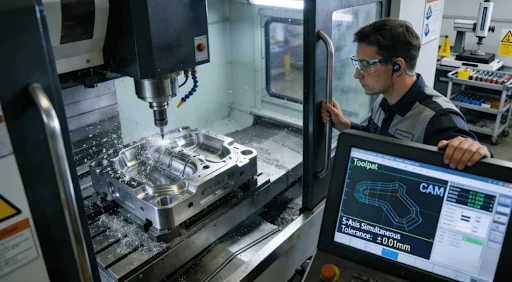
This section explains the core workings of CNC milling, focusing on its subtractive manufacturing essence, the roles of computer-aided design (CAD) and computer-aided manufacturing (CAM), the function of coordinate systems (e.g., G-code) in driving machine tool movements, and the relative motion between rotating cutters and stationary workpieces. Emphasis is placed on the concept of “digital instructions driving physical processing” as a foundation for precision and complexity.
1. The Essence of Subtractive Manufacturing
CNC milling operates on the principle of material removal from a solid block, where a rotating cutter progressively eliminates material to shape the final part. This process is governed by precise digital commands, ensuring high repeatability and accuracy compared to manual methods. For instance, in creating a prototype drone component, the system translates 3D models into toolpaths that dictate every cut, minimizing human error. The digital thread from design to production ensures each iteration maintains consistency, which is critical for high-volume manufacturing where even minor deviations can lead to significant losses. This approach contrasts with additive methods by enabling superior material integrity and surface finish for demanding applications.
Dive into this related post to uncover insights you won’t find elsewhere.
2. The Role of CAD/CAM in CNC Milling
CAD software generates detailed part models, while CAM systems convert these into machine-readable toolpaths. This integration allows for simulation and optimization before actual machining, reducing errors. Understanding standards like geometric dimensioning and tolerancing (GD&T) is crucial, as referenced in resources such as ASME Y14.5. The CAM software also factors in tool engagement and thermal management to prevent issues like tool deflection or overheating. For a deeper dive, readers can explore a more detailed exploration of CNC milling principles and applications. This synergy between design and execution underscores the importance of advanced software integration in modern manufacturing workflows.
3. Coordinate Systems and G-Code Fundamentals
The machine tool follows movements along linear (X, Y, Z) axes based on G-code instructions. This standardized programming language ensures consistency across operations. Mastery of these fundamentals enables manufacturers to interpret technical drawings accurately, adhering to protocols that avoid misalignments. G-code controls every aspect of the tool’s path, including spindle speed and feed rate, which are critical for maintaining precision. Training personnel in G-code programming and debugging can significantly reduce setup times and enhance overall productivity. This foundational knowledge is essential for troubleshooting and optimizing complex machining sequences in real-time.
How Do Different Types of CNC Milling Operations Address Specific Design Challenges?
This section contrasts 3-axis, 4-axis, and 5-axis CNC milling, highlighting their structures and suitability for specific challenges: 3-axis for cost-effective simple profiles, 5-axis for single-setup complex surface machining to reduce errors and improve efficiency. Concepts like face milling and contour milling are introduced.
- 3-Axis Milling for Prismatic Parts: Ideal for straightforward geometries, 3-axis milling involves movement in three linear directions, making it efficient for flat surfaces and basic contours. However, it requires multiple setups for complex shapes, potentially introducing cumulative errors. This approach suits high-volume production of standardized components, where simplicity translates to lower costs. The technology is particularly effective for prototyping and short runs, where quick turnaround is prioritized. Despite its limitations, 3-axis remains a cornerstone of machining for many industries due to its reliability and ease of use.
- 5-Axis Milling for Complex Geometries: By adding two rotational axes, 5-axis milling enables tool access from multiple angles, allowing deep cavities and free-form surfaces to be machined in one setup. This reduces handling time and enhances precision for parts like aerospace impellers. Adherence to international quality management standards such as ISO 9001 is critical here. The ability to maintain optimal tool orientation minimizes step-over distances and improves surface finish. This method is indispensable for medical implants and aerospace components where complex geometries are common. Investing in 5-axis technology can lead to significant long-term savings by reducing labor and material waste.
- Strategic Selection Based on Design Needs: Choosing the right operation type depends on factors like part complexity and tolerance requirements. For example, 4-axis milling offers a balance for rotational features, while 5-axis is essential for industries demanding ultra-high precision. Engineers must evaluate production volume and cost constraints when selecting the appropriate method. Utilizing decision matrices and simulation tools can aid in making informed choices. This strategic approach ensures that each project leverages the most efficient and effective machining process available, maximizing both quality and ROI.
What Key Applications Demonstrate the Impact of Precision CNC Milling in Critical Industries?
Through industry case studies, this section showcases the value of precision CNC milling, such as in aerospace for lightweight engine blades using titanium alloys, or medical devices for ISO 13485-compliant surgical components emphasizing dimensional stability.
1. Aerospace Components for Weight Reduction
In aerospace, 5-axis CNC milling produces turbine blades with complex airfoil shapes from materials like Ti-6Al-4V, achieving optimal strength-to-weight ratios. Manufacturers with certifications like AS9100D ensure compliance with rigorous standards. The process allows for integrative design where multiple components are consolidated into single parts. This reduces assembly time and enhances structural integrity and performance. The ability to machine heat-resistant superalloys makes CNC milling indispensable for next-generation aerospace applications.
2. Medical Devices for Biocompatibility
For medical implants, milling ensures high surface finish and dimensional accuracy in stainless steel or specialty alloys. This requires adherence to ISO 13485, guaranteeing safety and performance. Success in such projects often hinges on working with certified suppliers. The technology enables patient-specific solutions such as custom orthopedic implants with precise fits. Cleanroom-compatible machining further ensures that medical components meet stringent hygiene standards. These capabilities highlight how precision milling drives innovation in life-critical applications.
3. Automotive and Defense Applications
In automotive prototyping, milling enables rapid iteration of functional parts, while defense sectors rely on it for durable components. These applications highlight how precision principles drive innovation across fields. The automotive industry benefits from high-speed machining of engine blocks and transmission parts. In defense, milling of armored components requires adherence to strict material and performance specifications. The versatility of CNC milling supports both prototyping and full-scale production, making it a vital technology for these sectors.
How to Select the Optimal CNC Milling Parameters for Durable Materials like Aluminum and Titanium?
This section explores the interaction between material selection and machining parameters, using examples like aluminum 6061 and titanium Ti-6Al-4V to explain how cutting speed, feed rate, and tool geometry balance efficiency and tool life.
- Material Properties and Machinability: Aluminum offers excellent machinability and thermal conductivity, allowing higher speeds, whereas titanium’s high strength and low conductivity require slower feeds to avoid heat buildup. Referring to authoritative data on material properties, such as from the ASM Handbook, aids in parameter selection. Understanding material microstructure and behavior under stress is crucial for preventing issues like work hardening. This knowledge enables manufacturers to tailor their approaches for each material, optimizing both tool life and part quality.
- Parameter Optimization for Tool Life: Adjusting parameters like cutting depth and coolant use minimizes tool wear. For instance, with titanium, conservative feeds extend tool life while maintaining precision. This balance is key to cost-effective production. Utilizing adaptive machining technologies can dynamically adjust parameters in real-time based on sensor feedback. This proactive approach reduces the risk of tool failure and scrapped parts, enhancing overall efficiency. Continuous monitoring and data analysis are essential for long-term process improvement.
- Case Study on Aluminum vs. Titanium: A comparison shows that aluminum parts can be machined faster, but titanium demands meticulous parameter control to prevent defects. Real-world data underscores the importance of tailored approaches. For example, a titanium aerospace bracket may require 30% longer machining time but offers superior performance. Documenting these machining protocols and outcomes helps in building a knowledge base for future projects. This case-based learning fosters continuous improvement and innovation in handling diverse materials.
What Are the Essential Steps in a Streamlined CNC Milling Workflow from Design to Part?
This outlines the full workflow from CAD modeling and CAM programming to machine setup, machining, and quality inspection, emphasizing digital thread efficiency and traceability.
1. CAD Model Design and DFM Considerations
Starting with a detailed CAD model, designers incorporate design for manufacturability (DFM) principles to avoid issues like thin walls. This stage sets the foundation for efficient prototyping methods. Collaboration between design and manufacturing teams at this phase can identify potential challenges early. Utilizing simulation software to test virtual prototypes reduces the need for physical iterations. This proactive approach ensures that the final design is both functional and manufacturable, saving time and resources.
2. CAM Programming and Toolpath Generation
CAM software generates optimized toolpaths that simulate movements, preventing collisions. This step reduces errors and aligns with standardized inspection methodologies for verification. Advanced CAM systems also incorporate real-time adjustments for tool wear and material variations. The ability to visualize and refine toolpaths before machining minimizes risks and enhances precision. This digital preparation is crucial for complex and high-value components where errors are costly.
3. Quality Inspection and Documentation
Post-machining, coordinate measuring machines (CMMs) validate dimensions against CAD models, ensuring compliance with tolerances. This closed-loop process supports traceability in high-stakes projects. Automated reporting systems generate detailed quality certificates for each batch. Maintaining comprehensive records aids in audits and continuous improvement efforts. This rigorous inspection protocol is essential for industries with strict regulatory requirements, such as aerospace and medical devices.
Why is Partnering with a Certified Manufacturer Crucial for High-Stakes CNC Milling Projects?
This concluding section argues that technical capability must be paired with quality systems, explaining how certifications like ISO 9001, IATF 16949, AS9100D, and ISO 14001 ensure process control and risk management.
1. The Role of Quality Management Systems
Certifications enforce rigorous process controls, reducing variability. For example, ISO 9001 mandates continuous improvement, which is vital for complex parts. These systems provide a framework for accountability at every production stage. Regular internal and external audits ensure that standards are consistently met. This structured approach minimizes risks and enhances customer confidence and satisfaction.
2. Risk Mitigation Through Certification
Working with certified partners minimizes risks like non-compliance or delays, as seen in regulated industries. This approach safeguards project outcomes CNC milling principles. Certification also implies adherence to ethical and environmental standards, which is increasingly important for corporate responsibility. The traceability and documentation required by these standards provide a clear trail for troubleshooting and optimization. This proactive risk management is crucial for long-term project success.
3. Strategic Partner Selection Criteria
Evaluating manufacturers based on certifications and expertise ensures alignment with project goals. For organizations facing high-stakes challenges, partnering with a certified provider is a strategic decision. Those interested can explore professional CNC milling services to discuss specific requirements. Factors such as technological capabilities and industry experience should be weighed alongside certifications. This holistic evaluation process helps in selecting a partner capable of delivering consistent quality and innovation.
Conclusion
Precision CNC milling is not merely a cutting technique but a disciplined manufacturing system rooted in deep principles. By understanding operation types, material interactions, standardized workflows, and quality assurance, manufacturers can unlock its potential to transform complex designs into high-performance, reliable end products.
FAQs
Q1: What is the fundamental difference between 3-axis and 5-axis CNC milling?
A: The core difference lies in the degrees of freedom: 3-axis involves linear movements (X, Y, Z), suitable for simple parts but requiring multiple setups. In contrast, 5-axis adds rotational axes, enabling single-setup machining of complex geometries like contours and undercuts, improving accuracy and reducing time.
Q2: What materials are most commonly used in precision CNC milling, and why?
A: Common materials include aluminum alloys for their machinability, stainless steels for durability, and titanium alloys for strength in aerospace and medical applications. Selection depends on mechanical needs and environmental factors CNC milling principles.
Q3: How are tight tolerances achieved and verified in CNC milling?
A: Tight tolerances are achieved through high-precision machines, optimized toolpaths, and verified using CMMs for dimensional compliance with GD&T standards.
Q4: Can CNC milling be used for rapid prototyping?
A: Yes, it is effective for functional prototypes in final materials, offering accurate properties for validation before mass production.
Q5: What are the key advantages of CNC milling over conventional milling?
A: Advantages include superior precision, ability to produce complex geometries, efficiency through automation, and digital integration for error reduction.
Author Bio
The author is a precision manufacturing expert at LS Manufacturing, a company that helps global clients across industries with advanced manufacturing solutions from rapid prototyping to mass production. Facing complex manufacturing challenges? Contact the team for expert insights and an instant quote based on your project needs.
Explore more articles and uncover fresh perspectives on key topics at Management Works Media.