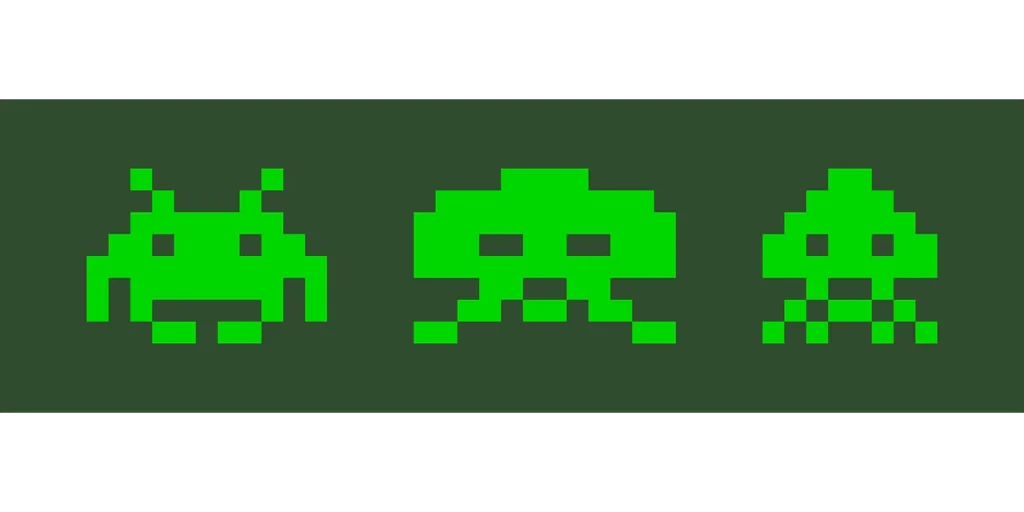
Space Invaders
Gaming has come a long way from its earliest incarnations, which involved simple blocky graphics and arcade machines. While Pong might have been one of the earliest available for play on home-based devices, it was games like Space Invaders that really captured the imagination and brought gaming to a much wider audience.
Space Invaders brought gaming out of arcades and into junior common rooms and youth clubs. The flat-top, table-like machines attracted clusters of young men and women, who watched as the defenders of Earth aimed their laser fire at the approaching alien ships, which advanced down the screen ever closer and faster. The gameplay was simple and addictive, and the design was iconic, albeit pixelated. Truth be told, the pixelation was part of the attraction. No one had anything like it, and space was all the rage. All our screens, including those at the movies, were full of space stories at the time, and things were about to go supersonic for the gaming industry.
The introduction of gaming at home
However, home gaming was still out of reach for most people until Amstrad, Sega, and Nintendo introduced devices that brought the action within the reach of most households, packing them with consoles, remotes, and infinite games. The Sega and Nintendo 8-bit consoles were groundbreaking at the time. You plug them into your existing TV and play in single or multiplayer mode at home. Notwithstanding that, for many of the early games, what happened on the screen did not directly correlate with the players’ intentions; this is the point where video gaming broke through.
By the time Sega launched its MegaDrive and Nintendo its SNES, Sonic and Mario were being pitched against each other by the marketing people, and teenagers in bedrooms and dens throughout the land settled into their gaming chairs, picked up their control pads, and whiled away endless hours in their bedrooms. While these devices could be plugged into any TV, they had migrated from the living room, and most households now had as many screens as people.
If people wanted to play with friends, they needed to be in the same physical location, and it would be many years before the technical infrastructure and networks would be in place for people to be able to play online. In fact, the gaming devices and games became so sophisticated over the years that as the world moved online, there was no way that they could be reliably delivered over flaky internet connections.
Taking backward steps to move forward
Ironically, when online gaming started out, games had to be massively simplified to make them playable. The graphical content was reduced, and people needed to use their imaginations to build worlds and embark on adventures.
Mobile gaming had always been popular with handheld devices, but it involved cartridges, disks, and specialized equipment; with the exception of simple games like Snake and Pac-Man, mobile games could not be played on cell phones. The introduction of the iPhone, with its full-color screen, extended battery life, and ability to connect to the internet, was a real game changer. We might look back and consider the 2007 iPhone as quaint and simplistic, but it was nothing short of revolutionary. Instead of needing separate devices for communication, listening to music, taking photos, and gaming, the smartphone promised to do everything in one place.
Get going
Up until now, online gaming was generally carried out on desktop PCs and laptops connected to the internet at home. Serious online gamers would attend competitions and conventions with Local Area Networks (LANs) to connect and play against each other. Smartphones said, ‘take me with you’, and all the hardware needed was for the software to catch up.
The two main problems early smartphone gamers encountered were:
Inadequate service to stay connected to an online game server
Inadequate device memory to download their favorite games
So, as they say, necessity is the mother of invention; in order to be able to play, a new approach was needed. This is where the app comes into its own. Apps were much less bulky and memory-hungry than most files and downloads. They could be easily offloaded, and a game like Subway Surfers or Flappy Bird could be played, regardless of whether the device was connected to the internet or not.
Apps transformed the gaming scene
One sector of the gaming industry that was transformed by the power of Apps was the world of iGaming. Due to security requirements, online casinos require very robust operating environments. Both the casino and players need to be kept safe. After all, players are trusting the casinos with financial data, and the casinos need to ensure that their games cannot be tampered with. It needs to be fair for everyone. Therefore, most iGaming was generally at-home entertainment until casino apps introduced it to smartphones.
Casino apps allow on-the-go access, and the best online platforms have created apps that seamlessly integrate with their browser versions. In fact, some online casinos promote themselves as ‘mobile first’ and have all their games curated for ease of access and playability. When you are placing bets, you do not want to accidentally have a fat thumb moment, so precision and accuracy in development are crucial. The quality of casino apps can vary enormously, but a review site like Casino.org ranks and recommends the best. Great apps will continue to work offline and seamlessly update the user’s account when service resumes.
Looking to the future
Most online games have mobile app versions that are ideal for playing on smartphones. While some people prefer to play on an optimized browser version, apps offer convenience, security, and a unique playing experience. While the earliest app games were brand-new inventions, some of the most popular today are lighter-weight versions of their online counterparts. The essential thing with any great app and browser game is the integration. You should be able to move seamlessly between devices without waiting for one system to catch up with the other. After all, we are all on the go these days. The last thing we want when we eventually flop down at home is to be in the wrong place in our game.