
As our digital lives moved from desks to pockets Portable power, the search for a power outlet became the modern traveler’s greatest challenge.
Remember when traveling meant hunting for wall outlets in crowded airport terminals or carrying a specialized briefcase just for your laptop’s power brick? As the smartphone revolution took hold, our dependence on high-speed mobile data and bright, power-hungry displays quickly outpaced the slow progress of battery chemistry. This gap gave birth to “low battery anxiety,” a very real modern stressor. What started as a niche, “nerdy accessory” for tech enthusiasts has transformed into a modern-day survival tool: the portable charger. This is the journey from bulky, slow-charging bricks to the high-wattage, intelligent power stations we carry in 2026.
Modern Charging Safety Input and Output
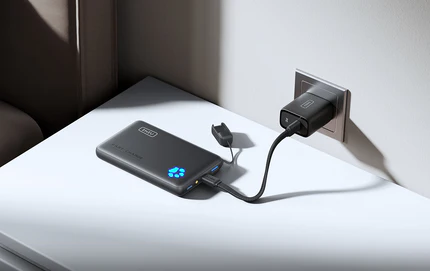
Safety begins at the source—how you provide power to your battery is just as important as how you draw it out.
Choosing the Right USB Charger
The first line of defense against battery failure is the USB charger you plug into the wall. Many users make the mistake of using generic, uncertified wall adapters to refill their power banks, not realizing that the input phase is when the battery is under significant thermal stress. High-quality chargers communicate with the power bank’s Battery Management System (BMS) to modulate voltage and current dynamically. A faulty or “no-name” adapter may bypass these safety protocols, pushing too much current and causing the internal cells to overheat, which is the leading cause of premature battery degradation.
Here is the expanded version of your text in English, maintaining the original headings and core message while naturally expanding the technical depth and practical advice to over 1,000 words.
The Intelligence of the Wireless Phone Charger
In the modern digital landscape, our reliance on mobile connectivity has transformed the portable power bank from an optional accessory into a critical lifeline. As smartphone processors evolve to handle complex AI tasks and high-resolution gaming, the demand for energy has skyrocketed. On the output side, the rise of the wireless phone charger has redefined convenience by removing physical wear on charging ports—a common failure point that historically sent millions of devices to the landfill prematurely.
Modern magnetic power banks are not just batteries in a plastic shell; they are sophisticated power management systems. One of the most vital advancements in this space is “Foreign Object Detection” (FOD) technology. To understand its importance, one must understand how induction works: the charger creates an alternating magnetic field that the phone’s internal coil converts back into electricity. However, magnetic fields do not discriminate between a phone’s receiving coil and a stray piece of metal.
This safety feature ensures that if a coin, key, or paperclip accidentally gets between the magnetic charger and your phone, the device instantly kills the power. Without FOD, these metal objects would act as “parasitic loads,” absorbing energy and heating up via induction—reaching temperatures high enough to cause severe burns, melt the device’s casing, or even ignite a fire. By integrating intelligent sensors that monitor energy efficiency and thermal fluctuations, modern chargers ensure that power is only delivered when a compatible device is detected.
Understanding the Enemies: Overcharging and Short Circuits
Even with modern convenience and “smart” features, the fundamental electrical risks of lithium-ion technology remain a constant reality. These batteries pack a high energy density into a small volume, making them volatile if the delicate chemical balance is disrupted.
The Mechanics of Overcharging
Overcharging occurs when a battery cell is forced to receive energy beyond its chemical capacity. In a perfect world, the Battery Management System (BMS) acts as a digital gatekeeper, communicating with the phone to stop the flow of electrons once 100% is reached. However, in damaged units or cheaply manufactured “no-name” devices, this gatekeeper can fail.
When excess energy is forced into a full cell, the liquid electrolyte—the medium that allows ions to move—begins to decompose into gas. This process creates internal pressure, leading to the battery “swelling” or bloating. If you notice your power bank’s casing starting to expand, or if the screen of your phone seems to be lifting, it is a sign that the internal pressure has reached a critical point. This phenomenon is often referred to in the tech community as a “spicy pillow.” This is a serious warning sign: the internal separators are under immense stress, and a puncture could lead to an immediate fire. To mitigate this risk, always prioritize power banks with certified “Auto-Shutoff” features that hardware-level cut the connection the moment capacity is reached.
The Danger of a Short Circuit
A short circuit is a catastrophic event where electricity finds an unintended, low-resistance “shortcut” through the circuit, bypassing the intended load. This isn’t just a technical glitch; it is an uncontrolled release of energy.
Short circuits can be triggered by internal damage, such as a microscopic tear in the battery separator caused by dropping the device, or by external debris. In our daily lives, pocket lint, metallic grit, or even moisture can bridge the pins in a USB-C or Lightning port. When this happens, the battery releases all its stored energy almost instantly. The result is “thermal runaway”—a rapid, uncontrollable increase in temperature. This feedback loop causes neighboring cells to fail, leading to intense smoke, hissing sounds (as gases escape), and eventually, chemical flames that are notoriously difficult to extinguish because they produce their own oxygen as they burn.
Top Safety Tips for Daily Use
While the engineering inside our devices is impressive, simple human habits are often the most effective defense against hardware failure and expensive repairs.
Stick to Certified Gear
The market is flooded with inexpensive charging solutions, but saving a few dollars is not worth the risk of a house fire. Only use accessories that carry UL (Underwriters Laboratories), CE, or RoHS certifications.
- UL Certification means the device has passed rigorous “torture tests,” including being crushed, dropped, and subjected to massive electrical surges.
- RoHS ensures the device is free from hazardous materials like lead and cadmium. These labels are your insurance that the manufacturer has invested in the safety logic required to protect your phone.
Master Temperature Control
Lithium batteries are like humans: they thrive in a narrow temperature range (ideally between 60°F and 80°F). Heat is the ultimate “silent killer” of battery longevity.
- Avoid the Greenhouse Effect: Never leave your power bank on a car dashboard in the summer. Internal car temperatures can exceed 140°F, which can permanently degrade the battery’s chemistry in a single afternoon.
- Let it Breathe: Avoid charging your phone while it’s buried under a blanket, pillow, or thick bedding. Modern fast-charging generates significant heat; if that heat cannot dissipate into the air, it builds up inside the device, accelerating the decomposition of the electrolyte.
Perform Regular Physical Inspections
Treat your power bank like a piece of precision equipment, not a durable brick. If your device has taken a hard fall onto concrete, do not simply check if it “still works.” Inspect the casing for cracks, listen for rattling, and feel for any localized heat while it’s idle. A “dented” battery cell is chemically unstable. Even if it works today, the internal structure may be compromised, leading to a delayed failure. If you suspect damage, stop using the device immediately and take it to a dedicated e-waste facility. Never throw lithium batteries in the regular trash, as garbage trucks are high-pressure environments where a damaged battery can easily start a fire.
Conclusion
Ultimately, the evolution of the power bank is a testament to our need for constant connection in an increasingly mobile world. We have moved past the era of carrying simple “spare batteries”; we now carry sophisticated, miniaturized power management stations that rival the complexity of the computers they charge.
As processor power continues to demand more energy for real-time AI processing and high-resolution graphics, the portable power station remains our most essential “plus-one.” However, with great power comes the responsibility of proper maintenance. By using quality connectors, ensuring proper alignment on wireless pads, and avoiding extreme environments, you can ensure your digital life never goes dark. By respecting the chemistry inside the box, you keep your hardware—and your home—safe for years to come.
There’s always more—click to explore articles that spark curiosity and learning.