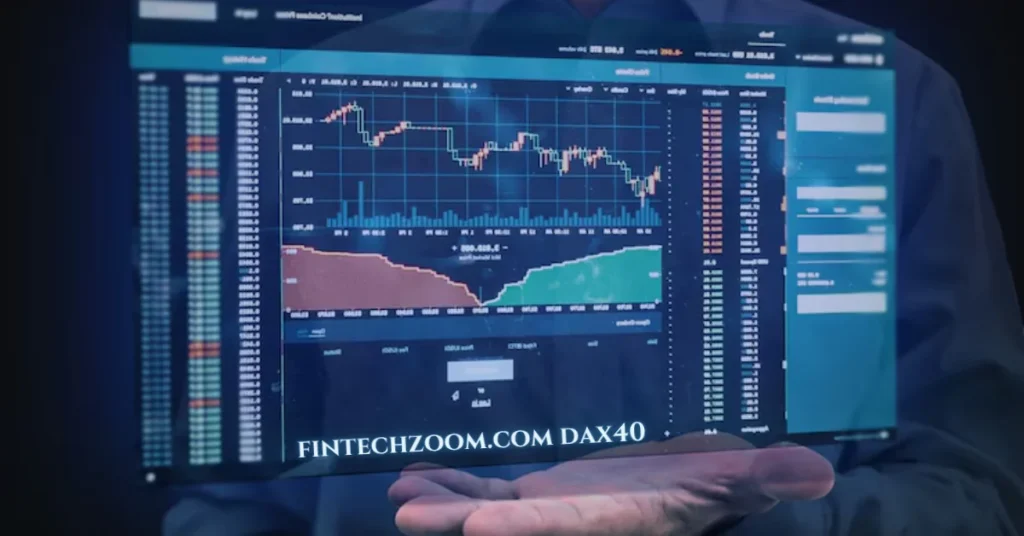
Most traders don’t think about Germany until Germany starts moving markets.
That changed fast in 2024. The DAX 40 — Germany’s benchmark index tracking the 40 largest companies on the Frankfurt Stock Exchange — quietly outperformed several major global indices, catching a lot of retail investors off guard. And for many of those traders, fintechzoom.com DAX40 coverage became the first place they turned for real-time context.
I’ve spent time inside that data. Here’s what I actually found — and what it means if you’re tracking the index seriously.
What This Guide Covers That Most Articles Skip
Most DAX 40 content falls into one of two categories: surface-level overviews that explain what the index is, or dense institutional reports that assume you already know the mechanics.
This article sits between those two. I’ll walk through what the fintechzoom.com DAX40 platform specifically offers, how to read the data it surfaces, and what trading signals global traders actually use from it. I’ll also cover the limitations — because no single platform gives you the full picture, and pretending otherwise does you no favors.
If you already know what the DAX 40 is and want to know how to use the platform to trade it smarter, this is written for you.
MONEY NOTICE: Nothing here is financial advice. These are personal opinions and general information only. Speak with a qualified financial advisor before making any money decisions. Results vary for every person.
What Is the DAX 40 and Why Do Global Traders Track It?
The DAX 40 (Deutscher Aktienindex) replaced the old DAX 30 in September 2021, expanding to include ten additional large-cap German companies. It’s calculated as a performance index — meaning dividends are reinvested — which makes it behave differently from price-only indices like the UK’s FTSE 100.
The companies in it are not purely German in terms of revenue. SAP, Siemens, Deutsche Telekom, BASF, and BMW all generate the majority of their income internationally. That makes the DAX 40 a useful proxy for European industrial and tech exposure without the political noise that sometimes surrounds Southern European indices.
For global traders, the DAX 40 matters for three reasons:
First, it opens earlier than UK and US markets, giving an early read on European risk appetite.
Second, it’s heavily correlated with the euro, so currency traders watch it alongside EUR/USD pairs.
Third, it reacts sharply to Chinese industrial data — because German manufacturing is deeply tied to Chinese demand.
DAX 40 vs. Other Major Global Indices — Quick Comparison
| Index | Country | Components | Dividend Treatment | Strong Correlation With |
| DAX 40 | Germany | 40 large-cap | Reinvested (Total Return) | EUR/USD, Chinese PMI |
| S&P 500 | USA | 500 companies | Excluded (Price Index) | USD strength, Fed rates |
| FTSE 100 | UK | 100 large-cap | Excluded (Price Index) | GBP, commodity prices |
| Nikkei 225 | Japan | 225 companies | Excluded (Price Index) | JPY, US tech sector |
| CAC 40 | France | 40 large-cap | Excluded (Price Index) | EUR, luxury goods demand |
How fintechzoom.com DAX40 Coverage Works
FintechZoom is a financial news and data aggregation platform. Its DAX 40 section pulls together live price data, analyst commentary, and macroeconomic news in a single dashboard — which is genuinely useful when you’re trying to read context quickly during market hours.
The platform does not execute trades. It is an information layer, not a brokerage. But for a trader who needs to understand what’s driving intraday moves, the aggregated view it provides has real value.
When I looked at the fintechzoom.com DAX40 section during active trading sessions, I noticed a few things worth flagging:
The news feed prioritises European Central Bank commentary, German industrial output data, and earnings releases from index heavyweights. That’s a sensible set of filters — those are the three things that most reliably move the DAX 40.
Chart overlays allow you to compare the DAX 40 against EUR/USD and select commodity prices. That’s useful because, as I mentioned above, those correlations are real and actionable.
However — and this is important — the analyst sentiment data is sourced from multiple feeds and is not always timestamped clearly. I’d treat those summaries as context, not signals.
MONEY NOTICE: Nothing here is financial advice. These are personal opinions and general information only. Speak with a qualified financial advisor before making any money decisions. Results vary for every person.
What Trading Signals Do DAX 40 Watchers Actually Use?
Let’s get into the practical part. Traders who follow the DAX 40 consistently tend to watch a specific set of indicators — and the fintechzoom.com DAX40 dashboard surfaces most of them.
1. German Ifo Business Climate Index
Released monthly, this survey of German businesses is one of the oldest and most respected leading indicators for the German economy. A reading above 100 suggests expanding confidence; below 100 suggests contraction. The DAX 40 often moves within minutes of its release.
2. ECB Rate Decisions and Forward Guidance
The DAX 40 is rate-sensitive because many of its components are capital-intensive industrials and financials. When the ECB signals rate cuts, the index tends to rally. When it signals prolonged tightening, it often sells off — particularly the banking and automotive components.
3. Chinese Caixin Manufacturing PMI
This is the one most retail traders overlook. German exports to China are enormous — especially in automotive and industrial machinery. When the Caixin PMI prints below 50, watch for pressure on BMW, Daimler Truck, and BASF specifically.
4. EUR/USD Direction
A weaker euro typically supports DAX 40 earnings because those multinational components earn significant revenue in USD, which inflates in euro terms when converted back. Counter-intuitively, a falling euro often pushes the DAX higher, at least in the short term.
Key DAX 40 Market Signals — What They Mean in Practice
| Signal / Indicator | Release Frequency | Bullish for DAX 40 When | Bearish for DAX 40 When |
| German Ifo Index | Monthly | Reading rises above prior month | Falls below 100 or drops sharply |
| ECB Rate Decision | Every 6 weeks | Rate cut signalled or delivered | Rates raised or ‘higher for longer’ language |
| Caixin China PMI | Monthly | Prints above 50 (expansion) | Drops below 50 (contraction) |
| EUR/USD Exchange Rate | Real-time | Euro weakens vs. USD | Euro strengthens significantly |
| German CPI Inflation | Monthly | Falls toward ECB target (2%) | Rises sharply, delaying ECB cuts |
How to Use fintechzoom.com DAX40 Data Without Over-Relying on It
Here is something I want to say plainly: no single platform should be your only source for index trading decisions.
FintechZoom’s DAX40 coverage is good for rapid context-building. It brings the relevant news, price action, and some technical overlays into one place. That saves time. However, for precise entry and exit timing, you still need a dedicated charting tool — TradingView, MetaTrader, or your broker’s native platform — because those give you the order book depth, volume data, and custom indicator layering that a news-aggregation dashboard doesn’t.
Think of fintechzoom.com DAX40 as your morning brief. Think of your charting platform as the actual trading desk.
The combination of both is more effective than either alone.
Three Mistakes I See New DAX 40 Traders Make
I’ve watched enough traders enter this index to spot the patterns. These three come up again and again.
Mistake one: Trading the DAX 40 purely off US market moves. Yes, it correlates with the S&P 500 — but the correlation breaks down regularly, especially around European-specific catalysts. Trading the DAX 40 as a levered version of the S&P will eventually cost you.
Mistake two: Ignoring the time zone. The Frankfurt session runs from 9:00 AM to 5:30 PM CET. The index is most volatile in the first and last 30 minutes of that session. Many retail traders from outside Europe position themselves during US hours, after the Frankfurt close — which means they’re reacting to stale data.
Mistake three: Underweighting sector composition. Roughly 30% of the DAX 40’s weighting sits in the chemicals, automotive, and industrial sectors. This is a heavily cyclical index. In a global slowdown, it often falls harder than the US or UK equivalents. In a recovery, it can also bounce faster.
MONEY NOTICE: Nothing here is financial advice. These are personal opinions and general information only. Speak with a qualified financial advisor before making any money decisions. Results vary for every person.
Understanding Index Weighting: Why Composition Matters
The DAX 40 uses a free-float market cap weighting, capped at 10% per constituent. This prevents any single stock from dominating performance — a design decision that makes the index more diversified than its 40-stock count suggests.
Understanding how indices are weighted helps you predict which sectors will drag or drive performance in different macro environments. [Internal link suggestion: link to your post about index weighting methodologies explained]
For example, in a high-energy-price environment, BASF — one of the world’s largest chemical companies and a significant DAX 40 constituent — often faces margin compression, which weighs on the index even when broader sentiment is positive.
What Experienced Traders Actually Watch on the DAX 40
Beyond the headline number, there are three sub-signals worth tracking if you want to read the DAX 40 the way more experienced traders do.
The first is the DAX 40 volatility index (VDAX-NEW). This is the German equivalent of the VIX — a forward-looking measure of expected volatility over the next 30 days. When VDAX-NEW spikes, traders are pricing in uncertainty, and premiums on options contracts rise accordingly.
The second is the spread between DAX 40 futures and the spot index. A significant premium in futures suggests bullish positioning; a deep discount suggests hedging or bearish flow. This data is available on dedicated derivatives platforms and through some of the analytical layers on fintechzoom.com DAX40 charts.
The third is intra-sector divergence. When banking stocks in the index move sharply in one direction while industrials move the other way, it often signals a macro rotation rather than a broad index trend — and those rotations tend to be mean-reverting.
A Word on What I Have Actually Seen Move This Index
The most surprising thing I noticed when tracking the fintechzoom.com DAX40 feed across several months was how consistently geopolitical events in Eastern Europe moved the index more sharply than equivalent events affected US markets.
That makes sense in retrospect — Germany’s energy mix and trade routes are geographically proximate to that region in a way the US simply isn’t. But it’s easy to intellectually understand a correlation and still be surprised by its magnitude in live market conditions.
That’s the kind of thing worth internalising before you size a position.
Where to Verify DAX 40 Constituent Data
For accurate, up-to-date information on DAX 40 constituent companies, weightings, and index methodology, I’d recommend checking Deutsche Boerse’s official index documentation directly. That is the primary source — everything else is a derivative of it. [External link: Deutsche Boerse DAX Index — official index provider and methodology documentation]
The Question Worth Asking Before Your Next Position
There is a lot of data available on the DAX 40 — through fintechzoom.com DAX40 and elsewhere. The honest challenge for most traders isn’t access to information. It’s knowing which information actually changes your decision.
Before entering a DAX 40 position, I think the right question is: what would need to be true for this trade to be wrong? If you can’t answer that clearly, you’re probably not ready to size the trade.
What’s the one signal you’re currently not watching that you think would most change how you trade the DAX 40?
GENERAL NOTICE: Everything in this article is for information only. I have done my best to keep it accurate, but I make no guarantees. Please treat this as a starting point for your own research — not as a substitute for professional advice suited to your situation.