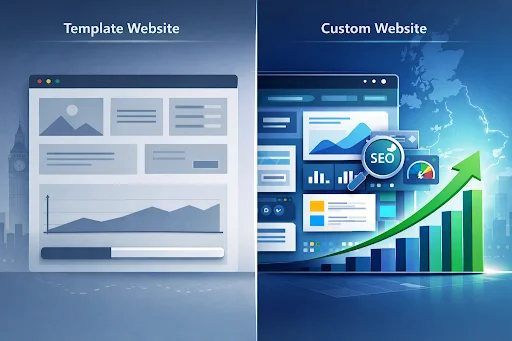
For UK SMEs, a website is no longer just a digital brochure. It is a revenue channel, a brand signal, and often the first meaningful interaction a customer has with your business. As margins tighten and competition increases across almost every sector, business owners are rightly asking a critical question: which type of website actually delivers better return on investment (ROI)?
At the heart of this decision lies a familiar dilemma — template websites versus custom web development. Templates promise speed and affordability, while custom solutions offer flexibility and long-term control. But when ROI is the priority, especially for growth-focused SMEs in the United Kingdom, the answer is rarely as simple as upfront cost.
This article takes a practical, business-first look at both approaches and explains which option delivers stronger website ROI over time.
Understanding the Two Approaches
Before comparing ROI, it’s important to define what we mean by template websites and custom web development — because they solve very different problems.
What Are Template Websites?
Template websites are built using pre-designed themes or layouts, often within platforms such as WordPress, Shopify, or Wix. The structure, functionality, and styling are largely predefined.
Common advantages:
- Lower upfront cost
- Faster launch times
- Minimal technical decision-making
- Suitable for basic informational sites
Typical limitations:
- Limited design and functionality flexibility
- Dependence on third-party plugins
- Performance overhead from unused features
- Generic user experience
Template websites are often used by early-stage businesses, sole traders, or SMEs that need an online presence quickly with minimal initial investment.
What Is Custom Web Development?
Custom web development involves designing and building a website specifically around a business’s goals, audience, and technical requirements. Rather than adapting a business to fit a theme, the website is engineered to fit the business.
Key characteristics of custom website design:
- Bespoke UX and UI aligned with brand strategy
- Clean, purpose-built code
- Flexible architecture for growth and integrations
- Greater control over performance, SEO, and security
While the initial cost is higher, custom web development focuses on long-term value rather than short-term convenience.
Cost vs Long-Term Value: The Real ROI Question
At first glance, template websites appear to “win” on cost. But ROI is not about what you spend — it’s about what you get back over time.
Upfront Costs
- Template websites: Lower initial investment, often bundled with themes and plugins
- Custom web development: Higher upfront cost due to strategy, design, and engineering
For many UK SMEs, this price difference heavily influences the decision. However, focusing only on upfront cost often leads to false economy.
Long-Term Website ROI
Over a three-to-five-year period, the cost gap narrows significantly.
Custom websites typically deliver stronger ROI by:
- Converting visitors more effectively
- Supporting ongoing SEO and content growth
- Reducing reliance on paid advertising
- Avoiding repeated redesigns and platform limitations
In contrast, template websites often require workarounds, paid plugins, and eventual rebuilds as the business outgrows the system.
Scalability, Performance, and Growth Readiness
Scalability
Growth is where template websites often start to break down.
As UK SMEs expand, they typically need:
- CRM or ERP integrations
- Advanced forms and lead qualification
- Multi-location or multi-service structures
- Custom reporting and tracking
Template websites struggle to scale cleanly, while scalable web solutions built through custom development are designed to evolve with the business.
Performance and Page Speed
Website performance directly impacts conversion rates and search visibility.
Template websites often include:
- Bloated code
- Excess scripts and styles
- Plugin conflicts
Custom web development allows:
- Lean, purpose-built code
- Faster load times
- Better Core Web Vitals scores
Faster websites don’t just rank better — they convert better, directly improving website ROI.
Branding, UX, and Conversion Optimisation
Brand Differentiation
In competitive UK markets, looking like everyone else is a disadvantage. Template websites reuse common layouts and interactions that customers subconsciously recognise.
Custom website design enables:
- Distinctive brand expression
- Tailored user journeys
- Clear messaging hierarchy
This differentiation builds trust and improves engagement — both essential for SMEs competing with larger brands.
Conversion Optimisation
Templates are built for general use, not for your specific audience or funnel.
Custom web development supports:
- Conversion-led layouts
- Custom CTAs and user flows
- A/B testing flexibility
- Data-driven UX improvements
Even small conversion rate improvements compound significantly over time, especially for businesses reliant on organic traffic or inbound leads.
SEO, Security, and Compliance Considerations
SEO Foundations
Search visibility is one of the biggest long-term ROI drivers for UK SMEs.
Custom web development provides:
- Clean URL structures
- Proper semantic HTML
- Optimised site architecture
- Easier implementation of structured data
Template websites often limit technical SEO flexibility or rely on plugins that only partially solve the problem.
Security and Compliance
UK businesses must consider:
- GDPR compliance
- Data handling requirements
- Plugin vulnerabilities
Template websites frequently depend on multiple third-party plugins, increasing security risk and maintenance overhead. Custom-built sites reduce dependency and offer more predictable security management.
Hidden Costs and Long-Term Risks of Templates
While templates look affordable, they often introduce hidden costs:
- Paid plugins and renewals
- Performance optimisation work
- Developer time fixing conflicts
- Partial rebuilds when limits are reached
Over time, these costs erode the perceived savings and delay growth initiatives.
Technical debt accumulates quietly, reducing marketing agility and making future changes more expensive.
When Template Websites Do Make Sense
To be balanced, template websites are not inherently “bad.”
They can be appropriate for:
- Early-stage startups testing an idea
- MVPs with limited functionality
- Short-term campaigns or microsites
- Businesses with no immediate growth plans
For these scenarios, templates offer speed and cost-efficiency.
When Custom Web Development Delivers Better ROI
Custom web development consistently outperforms templates for:
- Growing UK SMEs
- Businesses in competitive or saturated markets
- Companies reliant on organic search traffic
- Lead-generation or conversion-focused models
- Organisations requiring integrations or automation
In these cases, the website is not a cost centre — it is a strategic asset.
SEO & Performance: A Long-Term Advantage
From an SEO perspective, custom development provides future-proofing.
Benefits include:
- Faster adaptation to algorithm changes
- Easier UX improvements
- Cleaner migrations and updates
- Stronger foundations for content marketing
For SMEs investing in long-term visibility, this flexibility directly supports sustainable growth.
Conclusion: Which Delivers Better ROI for UK SMEs?
The question is not whether custom or template websites are “better” in absolute terms — it is which option aligns with your long-term business goals.
Template websites can be a sensible short-term solution. But for most growth-oriented UK SMEs, custom web development delivers superior website ROI through better performance, scalability, SEO, and conversion outcomes.
Before choosing, evaluate:
- Where your business needs to be in three to five years
- How reliant you are on digital acquisition
- Whether your website is supporting or limiting growth
Making a decision based on long-term value, rather than initial cost alone, is where true ROI is realised.
Trending now—don’t miss this post everyone’s talking about at Management Works Media.