
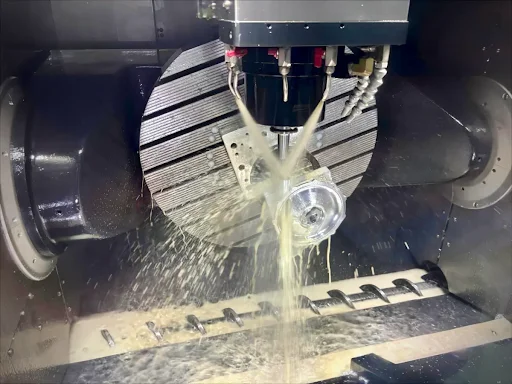
When an airframe bracket fails at 35,000 feet, investigations trace back to manufacturing. Last year, a commercial aviation supplier recalled 2,400 turbine housing components—not from design flaws, but from inadequate machining process controls causing microscopic stress risers that propagated into cracks after 800 flight hours.
Aerospace CNC machining represents the intersection of precision engineering, material science, and regulatory compliance where tolerances measured in ten-thousandths of an inch determine whether components perform reliably through 20+ year service lives or fail catastrophically. This guide breaks down actual capabilities, February 2025 cost structures, realistic lead times, and practical strategies reducing expenses without compromising flight safety.
What Modern Aerospace CNC Machining Delivers
Aerospace CNC shops produce structural brackets, engine components, avionics housings, actuator parts, and flight control elements using multi-axis milling, precision turning, and Swiss-type machining achieving tolerances from ±0.0005″ to ±0.005″ depending on feature criticality and material properties.
Core capabilities (AS9100-certified facilities):
Multi-axis machining (3-axis through 5-axis): Produces complex geometries in single setups, reducing setup error accumulation and maintaining tighter tolerances. 5-axis simultaneous machining enables compound angle features impossible with 3-axis sequential operations.
Swiss-type turning: Creates precision cylindrical components (shafts, pins, fasteners) with ±0.0002″ diametric tolerances and superior surface finishes (Ra 32 or better).
High-speed machining: Aluminum aerospace alloys (7075-T6, 2024-T3) machined at 15,000-25,000 RPM with specialized tooling achieving metal removal rates 3-5× faster than conventional speeds while maintaining dimensional accuracy.
Hard material machining: Titanium (Ti-6Al-4V, Ti-6-2-4-2), Inconel (718, 625), and stainless steel (15-5PH, 17-4PH) processed with carbide and ceramic tooling at controlled parameters preventing work hardening and maintaining metallurgical integrity.
Machine capabilities (typical aerospace-grade equipment):
Leading manufacturers: DMG MORI (NHX series), Mazak (Integrex i-series), Makino (a61nx), Haas (UMC-750), Hermle (C42 U dynamic)
Positioning accuracy: ±0.0001″ to ±0.0003″ depending on machine class Repeatability: ±0.00008″ to ±0.0002″ Spindle speeds: 12,000-60,000 RPM (depending on application) Tool capacity: 40-120 tool magazines enabling complex operations without manual intervention
Material Selection Impact on Cost and Capability
Material choice fundamentally determines machining economics, lead times, and achievable specifications.
| Material | Machinability Rating* | Cost ($/lb, Feb 2025) | Typical Tool Life** | Applications |
|---|---|---|---|---|
| Aluminum 6061-T6 | 100 (baseline) | $4.20-$6.80 | Baseline (100%) | Non-structural, housings, brackets |
| Aluminum 7075-T6 | 85 | $8.40-$12.20 | 85% | High-strength structural, airframe |
| Titanium Ti-6Al-4V | 25 | $28.50-$42.00 | 15-25% | Engine components, high-temp structural |
| Inconel 718 | 12 | $38.00-$58.00 | 8-15% | Turbine parts, exhaust systems, extreme temp |
| Stainless 15-5PH | 45 | $12.40-$18.80 | 40-50% | Landing gear, actuators, corrosion-critical |
*Relative to aluminum 6061-T6 = 100 **Tool life relative to aluminum baseline
Cost multiplication factors:
- Titanium machining: 4-8× aluminum costs (slower feeds, specialized tooling, longer cycle times)
- Inconel machining: 6-12× aluminum costs (extreme tool wear, thermal management challenges)
Case study: Actuator bracket material optimization (November 2024)
Original spec: Ti-6Al-4V, 85mm × 45mm × 12mm, ±0.002″ tolerances Machining cost: $380/piece (15-piece prototype run) Lead time: 4 weeks (material procurement + machining + inspection)
Engineering analysis: Stress analysis showed 7075-T6 aluminum adequate with design modifications (increased wall thickness 1.5mm, added reinforcement ribs)
Optimized spec: 7075-T6 aluminum, revised geometry Machining cost: $95/piece (60% less material cost, 75% faster machining) Lead time: 10 days Weight: Reduced 18% (additional performance benefit) Investment savings: $4,275 on 15-piece run, $28,500 annually (projected 100-piece/year volume)
Actual Cost Structures (February 2025 Benchmarks)
Machine hourly rates (US aerospace-certified shops):
- 3-axis CNC milling: $85-$140/hour
- 4-axis indexed milling: $120-$185/hour
- 5-axis simultaneous milling: $165-$280/hour
- CNC turning (2-axis): $75-$125/hour
- Swiss-type turning: $110-$175/hour
Additional cost elements:
- Setup/programming: $250-$850 per setup (amortized across quantity)
- Tooling (special cutters, fixtures): $400-$2,500 per job
- First article inspection (FAI): $350-$1,200 depending on complexity
- Material certification/traceability: $85-$180 per lot
- CMM inspection reports: $120-$420 per part (depending on features)
- AS9100 documentation overhead: 8-15% of machining cost
Sample part cost breakdown (100-piece run, 7075-T6 aluminum bracket, moderate complexity):
- Material: $1,240 (12.4 lbs @ $10/lb with waste factor)
- Programming/setup: $680 (amortized)
- Machining time: $4,800 (40 hours @ $120/hr)
- Inspection/FAI: $950
- Documentation/certification: $420
- Total: $8,090 ($80.90/piece)
Economies of scale: 500-piece run reduces per-piece cost to $52-58 through setup amortization and optimized tooling investment.
Realistic Lead Time Expectations
Prototype/low-volume (1-10 pieces):
- Simple geometry, aluminum, standard tolerances: 5-10 business days
- Complex geometry, exotic material, tight tolerances: 3-5 weeks
- Material procurement for specialty alloys: +1-3 weeks
Production runs (AS9100/NADCAP certified):
- 25-100 pieces, aluminum: 4-6 weeks
- 25-100 pieces, titanium/Inconel: 6-9 weeks
- 100-500 pieces: 8-12 weeks
- Material lead times (specialty alloys): 2-6 weeks additional
Lead time breakdown (typical 50-piece titanium component):
- Material procurement: 14 days
- Programming/fixturing: 3 days
- First article machining: 2 days
- FAI and approval: 3 days
- Production run: 18 days (0.36 days/piece including inspection)
- Final inspection/documentation: 2 days
- Total: 42 days (6 weeks)
Expedite options: 25-50% rush premium can reduce timelines 30-40% when machine capacity available.
Tolerance and Inspection Requirements
Typical aerospace tolerance classes:
Critical mating features: ±0.0005″ to ±0.001″ Important functional features: ±0.002″ to ±0.003″ Non-critical features: ±0.005″ to ±0.010″ General dimensions: ±0.010″ to ±0.030″
Surface finish requirements:
- Mating surfaces: Ra 32 or better (0.8 μm)
- Functional surfaces: Ra 63-125 (1.6-3.2 μm)
- Non-critical surfaces: Ra 125-250 (3.2-6.3 μm)
Mandatory inspection for flight hardware:
- First Article Inspection (FAI) per AS9102
- CMM dimensional verification (Zeiss, Hexagon, Mitutoyo equipment)
- Material certification (certs of conformance, test reports)
- Non-destructive testing (fluorescent penetrant, X-ray, ultrasonic for critical parts)
- Surface finish verification (profilometer measurement)
- Documentation package (inspection reports, material certs, process travelers)
Inspection costs: Add 12-20% to machining costs for certified aerospace work.
Certification Requirements and Compliance Costs
AS9100 (aerospace quality management): Industry-standard certification for aerospace suppliers. Verifies quality systems, process control, traceability, and continuous improvement. Annual maintenance cost: $15,000-$45,000 depending on facility size.
NADCAP (special process accreditation): Required for heat treating, welding, NDT, chemical processing. Accreditation cost: $8,000-$25,000 per process, biannual audits.
Material specifications: AMS (Aerospace Material Specifications) define chemistry, heat treatment, mechanical properties. Common specs: AMS 4027 (6061-T6), AMS 4078 (7075-T6), AMS 4911 (Ti-6Al-4V), AMS 5662 (Inconel 718).
Certification impact on pricing: AS9100-certified shops typically charge 15-25% premium over non-certified shops, but provide traceability and process control preventing costly field failures.
Cost Reduction Strategies Without Compromising Safety
Design optimization:
- Increase corner radii (3mm minimum vs sharp corners reduces machining time 15-25%)
- Minimize deep pockets requiring long tools (reduces deflection, improves tolerance capability)
- Design for standard tooling (eliminates $400-1,200 special cutter costs)
- Consolidate features accessible from minimal setups (each setup adds $180-350 cost)
Tolerance rationalization:
- Apply tight tolerances only to critical mating/functional features
- Relax non-critical dimensions to ±0.010″ or greater (reduces inspection time 20-30%)
Material alternatives:
- Aluminum instead of titanium where strength-to-weight allows (4-8× cost reduction)
- Standard alloy grades vs. premium grades when performance adequate
Volume optimization:
- Batch orders to amortize setup costs
- Commit to annual contracts for volume pricing (10-18% discounts typical)
Practical example: Redesigning bracket with 5mm corner radii (vs 2mm), reducing tight-tolerance features from 12 to 4, and increasing non-critical tolerances to ±0.015″ reduced machining time 28% and inspection time 35%, saving $34/piece on 200-piece annual volume.
Practical Procurement Checklist
When requesting quotes, provide:
- Complete engineering drawings with GD&T callouts
- Material specification (AMS/ASTM standards)
- Surface finish requirements (Ra values)
- Quantity and delivery schedule
- Inspection requirements (FAI, material certs, CMM reports)
- Special processes needed (heat treat, anodizing, passivation)
Evaluate suppliers on:
- AS9100 certification (current certificate)
- NADCAP accreditation (if special processes required)
- Equipment capability (machine specs, inspection equipment)
- Material traceability systems
- Customer references in aerospace sector
- Quality escape rate (<2% for qualified suppliers)
FAQs: Aerospace CNC Machining Essentials
What tolerances are achievable in aerospace machining?
Standard capabilities: ±0.002″ to ±0.005″ for most features. Precision capabilities: ±0.0005″ to ±0.001″ for critical dimensions using high-precision equipment with temperature control. Tolerances tighter than ±0.0005″ require grinding or EDM finishing operations, increasing cost 40-80%.
How much does aerospace CNC machining cost?
Simple aluminum parts: $45-$120/piece (low volume). Complex titanium components: $280-$850/piece. Inconel engine parts: $650-$2,400/piece. Costs vary dramatically based on material, complexity, tolerance, quantity, and certification requirements. Request detailed breakdowns showing material, machining hours, setup, and inspection costs separately.
What’s the difference between AS9100 and ISO 9001?
AS9100 includes all ISO 9001 requirements plus aerospace-specific additions: configuration management, risk management, first article inspection, counterfeit part prevention, and foreign object debris (FOD) control. AS9100 certification mandatory for most aerospace prime contractors and critical for flight hardware traceability.
Can I use non-certified shops for aerospace prototypes?
For design verification prototypes (non-flight hardware), yes—saves 15-25% on costs. For flight-test hardware or production parts, AS9100 certification mandatory for liability protection and regulatory compliance. Even prototypes benefit from aerospace shop expertise preventing manufacturability issues in production.
How do I reduce lead times for aerospace parts?
Maintain material inventory for common alloys (eliminates 2-6 week procurement). Provide complete documentation upfront (prevents revision delays). Approve first article promptly (2-3 day delays common). Consider semi-finished blanks vs. raw stock (reduces machining time 25-40%). Pay expedite premiums when timeline critical (25-50% premium typical).
What inspection is required for certified aerospace parts?
Minimum: First Article Inspection (AS9102), dimensional verification (CMM reports), material certification (certs showing chemistry/properties), visual inspection. Additional for critical parts: NDT (penetrant, X-ray, ultrasonic), metallurgical analysis, mechanical testing. Inspection documentation must accompany every shipment for traceability.
The Precision That Keeps Aircraft Airborne
CNC machining for aerospace isn’t conventional manufacturing—it’s precision engineering under regulatory oversight where process control, material traceability, and dimensional verification prevent catastrophic failures affecting hundreds of lives.
The smartest procurement strategy isn’t chasing lowest quotes—it’s designing manufacturable parts, selecting qualified suppliers, and investing in process control that delivers reliable components surviving decades of service. That discipline separates programs that succeed from those grounded by quality escapes.
What aerospace machining challenge are you facing, and what’s preventing you from optimizing cost without compromising safety?