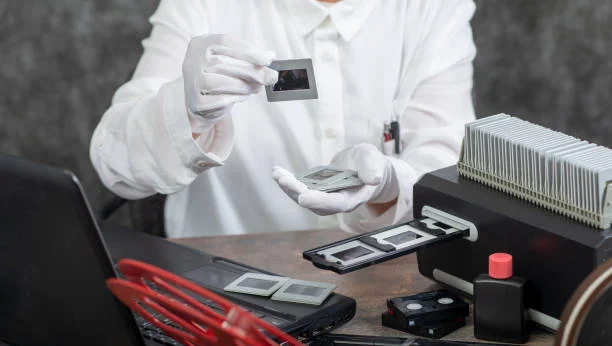
Businesses often overlook the treasure trove of archival media. These slides, prints, and transparencies capture client history, marketing milestones, or institutional memory.
These assets may suffer damage from water, sunlight, or mold, but you don’t have to consign them to the shred-heap. Early intervention and a structured workflow can make all the difference.
In this context, photo digitization becomes your first line of defense, preserving what remains and enabling recovery of what’s been lost.
Why Slides and Prints Are Vulnerable
1 Water and Moisture Damage
- Water exposure or high humidity can cause emulsions on film or print to swell, separate, or adhere to other surfaces.
- Warping, rippling,g or stuck-together slides are common outcomes.
- Moist conditions also promote mold growth, which makes the damage worse and increases the risk of irreversible loss.
2 Sunlight or UV Exposure
- Exposure to direct sunlight for long causes fading and bleaching of dyes in prints and slides.
- UV radiation accelerates the chemical breakdown of photographic materials, and the brightness and colour shifts become permanent.
3 Mold and Biological Attack
- Storage in damp, poorly ventilated spaces lets mould and bacteria feed on the organic binders of photographs.
- Signs include fuzzy growth, discoloration, and even holes in the surface. Once mould takes hold, it can continue degrading both the photograph and nearby items.
Can Damaged Slides And Photos Be Saved?
When a business discovers that archival slides or photographs have been exposed to water, sunlight, or mold, the first instinct is often to assume the damage is permanent.
In reality, most forms of deterioration fall on a spectrum, and significant portions of the image can often be rescued, provided you act quickly and follow a structured process.
The true determinant is not whether damage occurred, but how far the chemical and physical degradation has progressed.
What Determines Salvageability?
Four core factors influence how much you can restore:
- Type of damage, like water vs. UV vs. mold.
- Duration of exposure.
- Material types include Kodachrome, Ektachrome, cellulose acetate film, resin-coated paper, and fiber-based paper.
- Immediate handling after the event, drying wet prints promptly.
1 Water Damage
Water can cause many issues, such as:
- Emulsion softening: The chemical layer that holds the image becomes soft and easily scratched.
- Blocking: Stacked prints or slides may fuse together.
- Staining and streaking: Dirty or mineral-rich water leaves deposits.
- Warping: Film bases buckle or curl as they dry.
The good news is that most water-related distortions can be mitigated. If the emulsion hasn’t physically separated or flaked off, a high-resolution scan followed by digital correction can recover much of the original detail.
In severe cases, where emulsions peel, partial recovery is still possible, but expect visible losses.
The first 24 to 48 hours after water exposure are essential. Acting quickly prevents mold growth and reduces staining.
2 Sunlight and UV Damage
Sunlight, especially UV, does not physically distort the photograph, but chemically alters the dyes. Common symptoms include:
- Yellowing of highlights
- Blue or magenta shifts
- Overall fading across the frame
- Dye-layer failure in older color film stocks
Unlike water damage, fading caused by UV exposure cannot be reversed on the physical print or slide. Chemical breakdown of dyes is permanent. However:
- Digital restoration can often rebalance color, increase contrast, and recover faint detail.
- If any color channel has not fully faded, the software can reconstruct missing tones.
- Modern AI tools can interpolate lost detail, which is useful for marketing archives where “approximate continuity” is acceptable.
3 Mold Damage
Mold thrives in dark, humid environments, precisely where businesses tend to store old slides and prints. Mold poses two threats:
- Biological: It eats the organic binders in the emulsion.
- Chemical: It secretes acids that permanently stain or etch the surface.
Common mold damage includes:
- Spider-web or spot patterns across the image
- Etched pits or holes in the emulsion
- Discoloration
- Softened or slimy surfaces
Once mold penetrates the emulsion, the physical damage is irreversible. However:
- Superficial mold can be cleaned by professionals.
- Even heavily mold-damaged slides often contain some recoverable color and detail.
- High-resolution scanning captures what remains, and digital tools can fill gaps, remove mold patterns, and restore contrast.
Which Types of Damage Are Usually Salvageable?
Below is an expanded version of the salvageability table with more context and practical guidance:
| Damage Type | Salvage Potential | What Can Usually Be Recovered | What’s Often Lost | Key Considerations |
| Mild fading/mild discoloration | High | Color accuracy, contrast, and sharpness | Minor tonal shifts | UV damage is permanent physically, but very fixable digitally |
| Moderate water stains/warping | Medium–High | Most details, shape correction, stains | Some color irregularities | Dry carefully; scan before attempting flattening |
| Blocking (prints stuck together) | Medium | Portions of both prints | Areas where emulsions fused | Requires professional separation |
| Superficial mold (surface level) | Medium | Most image data | Small spots, minor discoloration | Needs cleaning + digitization ASAP |
| Penetrative mold (into emulsion) | Low | Some composition, outlines, partial detail | Color integrity, fine detail | Remove from storage immediately; digitize what’s left |
| Severe fading (dye layer failure) | Low | Rough tonal structure | Full color range | Digital reconstruction is possible but limited |
| Physical scratches/gouges | Variable | Unaffected regions | Scratched areas | Digital retouching can conceal mild scratches |
Why Digitization Greatly Expands Restoration Possibilities
Digitizing damaged photographs does more than simply “convert them.” It opens the door to:
- Color reconstruction
- Contrast boosting
- Selective noise removal
- Rebuilding missing sections
- Isolating mold patterns and digitally removing them
For businesses preserving historical marketing materials, client documentation, or product archives, digital restoration often delivers results far better than what the original physical item could achieve, even when new.
Conclusion
If your business holds a backlog of old slides or photographs, don’t assume that water damage, sunlight fading, or mould has rendered them irrecoverable.
With the right approach, starting with photo digitization, careful handling, and smart storage, you can salvage significant value from deteriorating media.