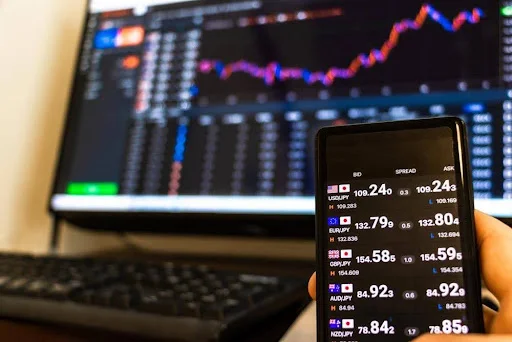
If you take a look at a chart and observe movements of EUR/USD, it appears to be very simple. All it has is a line that goes up, a line that goes down, candles are formed, and then there are patterns. Most traders believe in the force of price movements, thinking that “buyers are stronger” or “sellers took control.” But that’s not really how the market works.
There is a process behind every candle, which is almost unseen by any retail trader. Currency prices are not determined by a single exchange, a single company, or even a single country. Forex is a decentralised market. There are no central buildings in which all trades take place. Instead, price is created through a world network of banks, liquidity providers, brokers, hedge funds and traders – all interacting simultaneously.
To really get an understanding of forex trading, you have to stop thinking of charts as predictions and start thinking of them as records of transactions.
The Market Is Basically a Giant Negotiation
At its simplest, the forex market is simply an agreement on value.
To understand how forex trading works, imagine a street market. One of the sellers is selling gold at $800 per ounce. A buyer says $7,99. And they take negotiations until they both accept a price. The final agreed price becomes the market price.
Forex works exactly like that, except millions of negotiations occur each and every second.
Banks are constantly quoting two prices:
- a price they are prepared to buy (bid)
- a price they are willing to sell (ask)
When a buyer accepts the ask price, a transaction occurs, and the price prints up. As a seller accepts the bid, the price moves downwards. Candles don’t move because the market “decides” a direction, but they move because trades actually happen.
Charts are not forecasts. They are the history of transactions.
Who Actually Moves the Market?
Retail traders tend to believe that they move markets. Realistically, they don’t. But even thousands of retail orders are minuscule compared to institutional flow.
A list of the biggest participants includes:
- Commercial banks: give continuous pricing
- Liquidity providers: supply tradable volume
- Hedge funds: take directional positions
- Corporations: exchange currency for business operations
- Central banks: influence monetary policy
For example, when the airline company buys billions of dollars to pay for fuel contracts, it creates real demand. That demand must be filled. Banks spread the orders among the market gradually so as not to give a shock to the price. This is the reason why markets tend to be slow in movement rather than instantly jumping to a new value.
This is why markets trend gradually instead of jumping instantly to a new value.
Price does not move on the basis of charts. Charts are formed due to orders.
Role of Liquidity
Here’s the part most beginners never learn.
Markets do not go where traders ‘think’ price should go. Markets tend to flow where there are orders.
Large participants are not able to put huge trades at random prices. They need liquidity to fill their position. Without it, the price would shoot up out of control.
So where does liquidity sit?
This is exactly where traders put predictable orders:
- stop losses
- breakout entries
- reversal trades
This is why price often hits a level perfectly and turns. It is not magic. It is inventory matching.
When price suddenly jumps up from above a high and immediately reverses that is often the work of liquidity grabbing. Stops trigger and orders fill and once you have the large position filled, then there is no further need for the price to remain there.
The Role of News and Central Banks
Economic news does not magically move prices either. It changes expectations. Currencies are a representation of economies. As the inflation figures, interest rates or employment figures fluctuate, traders adjust their expectations of a currency’s future value.
Central banks are particularly powerful because interest rates control where money goes in the world economy. If one country offers a higher rate of interest, money flows to that particular country, and the supply of that currency increases.
Price moves due to the movement of money. So, the actual number of capital the chart is showing is capital migration in real time.
Why do Spikes Happen so Fast?
You’ve probably seen it: calm market, then suddenly a 30-pip candle in seconds. That generally happens when liquidity vanishes.
In the case of news releases or of low-volume sessions, there are fewer resting orders in the market. If a large order comes in, the price must jump to the next available level that somebody is willing to take the other way.
Think of it like this: if you have three sellers at a price, and a huge buyer is announced, the price has to move higher until it finds more sellers. The candle that you see is just the path of the price that was looked for on matching orders.
Price movement is not a force. It is a search.
Why Small Timeframes Feel Random?
Many traders get frustrated with 1-minute or 5-minute charts. They say the market is manipulated or unpredictable.
And reality?
They are observing micro-liquidity fluctuations.
In the short timeframes, order matching rather than direction is what dominates. Minor imbalances of buy and sell continually come and go. Without a more substantive institutional goal underlying the move, the price is noise. This is the reason why strategies such as forex scalping are hard. They rely a lot more on execution speed, spreading conditions and correct timing in lieu of analysis. A setup is possible, but the move may fail because it was too small to overcome trading costs.
On higher timeframes, however, institutional activity is visible. The noise is smoothed out, and the structure becomes apparent. It did not become clearer from the chart. You brought a Zoom to the meaning of participating.
Now, you must be thinking as to why understanding this changes trading. Right?
To answer, once the traders know how the price is made, they stop asking, “Where will the market go?” and begin to ask, “Where are orders likely sitting?”
And, this shift changes everything, like:
- Breakouts become liquidity events
- Reversals become trapped traders
- Consolidation becomes order accumulation
- You stop chasing candles and start reading behaviour.
- You also realise why patience matters.
Markets spend a great deal of time building positions, not moving. The big moves only come after sufficient orders are collected.
Conclusion
To conclude, currency prices are not just any random lines on a screen. They are the visible outcome of hidden negotiations between institutions, businesses and traders throughout the globe. Each candle is an agreement of value which is completed. Understanding the mechanics behind the formation of a price doesn’t just enhance analysis – it alters mindset.
You can say that trading stops being a prediction and becomes an observation. When you realise that charts gauge transactions, liquidity and participation, you really don’t try to outguess the market. You learn to follow.