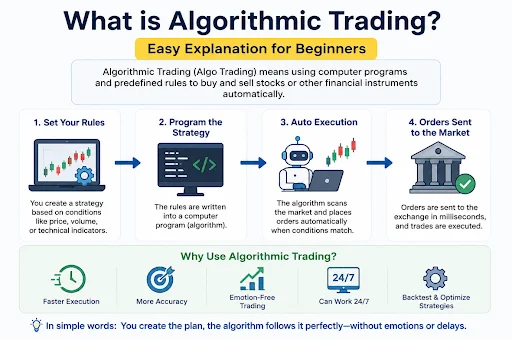
Many users picture trading as someone sitting at multiple screens, constantly buying & selling assets all day. But in today’s world, much of trading is automated by computers. Instead of manually placing every trade, traders can use the systems that follow pre-set instructions & execute trades automatically based on predefined conditions. This is also known as algorithmic trading.
If you are new to trading, this concept may sound technical at first. However, once you understand the basics of algo trading, it becomes easier to see its role in modern financial markets.
What is Algorithmic Trading?
Algorithmic trading or algo trading is the process of using computer programs to automatically place trades based on predefined rules.
In simple terms, traders create a set of rules including price, timing or volume, and the computer follows them to trade. Thereby, eliminating the need for constant manual monitoring.
For instance, a trader may instruct a system to buy a stock if its price drops below a certain level & sell it once the price rises, without manually watching charts all day.
Today, algorithmic trading is widely used across various financial markets to include execute trades automatically based on predefined rules.
Common Type of Algorithmic Trading Strategies
There are different strategies used in algorithmic trading. However, beginners do not need to master all of them at once, but understanding a few basics can help.
- Trend-Following Strategies
These strategies attempt to identify & follow market trends. The algorithm places trades based on the market’s direction.
- Arbitrage Strategies
Arbitrage strategies aim to exploit price differences for the same asset across different markets.
- Mean Reversion Strategies
This strategy is based on the idea that prices may eventually return to their average levels after moving too far in one direction.
- High-Frequency Trading
High-frequency trading uses computer systems to place trades at a very high speed. This type of trading is usually more advanced and commonly utilised by large financial institutions.
There are different strategies used in algo trading. However, beginners do not need to master all of them at once but understanding a few basics one can help.
How Does Algorithmic Trading Work?
Let’s look at the step-by-step procedure to understand how does algorithmic trading works:
Step 1. Creating a Trading Strategy
The first step is to create a Trading Strategy. A trader decides the conditions under which the trades should happen. These conditions may be based on:
- Current market trends
- Technical Indicators
- Price movements
- Timing
Step 2. Monitoring the Market
Once the strategy is programmed into the system, the algorithm continuously monitors live market data. It checks whether the market conditions match the predefined trading rules.
Because computers can process information very quickly, algorithms can monitor markets much faster than manual traders.
Step 3. Executing Trades Automatically
When the conditions match the strategy, the algorithm automatically places the trade. This automated execution helps traders respond quickly to market movements without having to manually place every order.
Pros & Cons of Algorithmic Trading
Like any trading method, algorithmic trading has both advantages and disadvantages. Understanding both sides can help beginners build a more balanced view of algo trading.
Pros of Algorithmic Trading
- Faster Trade Execution: Algorithms can analyse market conditions & place trades much faster than humans. This can be useful in fast-moving markets where prices change quickly.
- Reduced Emotional Trading: Manual trading decisions are often influenced by emotions. Algo trading follows pre-defined rules, which helps reduce emotional decision-making.
- Continuous Market Monitoring: Algorithms can monitor the market continuously without needing breaks. This allows the traders to react to opportunities even when they are not actively watching the charts.
- Better Consistency: Since the system follows the same rules every time, trading decisions may become more consistent over time.
- Time Efficiency: Automation can reduce the need to manually monitor the market throughout the day.
Cons of Algorithmic Trading
- Technical Failures: Issues such as internet outages, software bugs, or system failures can affect algorithmic trading performance.
- Poor Strategy Design: If the trading strategy is weak or poorly designed, the algorithm may continue making ineffective trades automatically.
- Market Volatility Risks: Sudden market movements or unexpected events can disrupt trading algorithms, especially during periods of high volatility.
- Requires Monitoring: Although trading is automated, algorithms still need supervision & regular adjustments to ensure that they are functioning properly.
- No Guaranteed Profits: Algo trading does not guarantee success. Financial markets are unpredictable & losses are still possible.
Conclusion
Algorithmic trading can help traders place trades faster & reduce any emotional decision-making. In today’s world, many traders use automated systems to monitor markets & execute trades more efficiently. However, it is still important to have a proper strategy, risk management plan, and a clear understanding of how does algorithmic trading works. As a beginner, it is important to start with proper education, understand the risks involved, and continue learning before engaging in algorithmic trading.