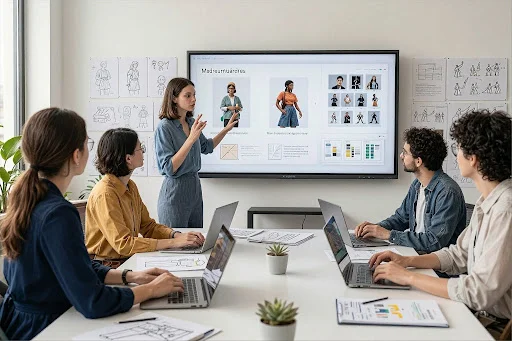
A surprising number of business leaders still treat AI character tools as novelty software. That view is already outdated. In my experience, the smarter use case is not entertainment for its own sake. It is operational. When creative teams need to move from a vague idea to a usable visual direction, these tools can shorten feedback loops, reduce internal friction, and help teams make decisions earlier.
That is why platforms such as an OC generator are starting to matter beyond hobby circles. What used to be seen as a niche tool for fandom culture or personal character design is now finding a place in marketing, branding, content planning, and early-stage product storytelling. The technology is not replacing strong creative judgment, but it is becoming a practical layer inside the process.
Why This Matters to Management, Not Just Designers
The biggest cost in creative work is often not execution. It is uncertainty.
A team may spend days discussing what a mascot should feel like, what kind of visual personality suits a campaign, or how a fictional brand ambassador should appear across channels. Those conversations usually involve multiple stakeholders, each carrying a slightly different picture in mind. When no one can see the same direction clearly, projects slow down.
That is where AI-based character tools become useful. They help teams externalize ideas earlier. Instead of debating abstractions, people can respond to visuals. That sounds simple, but in business terms it changes the rhythm of collaboration. Meetings become more concrete. Revisions become easier to define. Approval cycles tighten because the conversation moves from “What do we mean?” to “Is this close enough to refine?”
The Real Value Is Speed With Structure
There is a lazy narrative that AI tools are valuable only because they are fast. Speed matters, but speed without structure often creates more clutter than progress. What makes character-generation tools worth considering is that they offer fast iteration within a defined creative frame.
If a team already knows the target audience, brand tone, category, and emotional direction, rapid visual experimentation becomes productive. You can test whether a concept should lean playful or premium, futuristic or nostalgic, minimal or expressive. That kind of comparison would normally take much longer if every route needed to be sketched from scratch before anyone could react.
Used well, the tool is not the strategy. It is the bridge between strategy and discussion.
Where Businesses Are Actually Using These Tools
The practical applications are broader than many managers assume. They are no longer limited to game communities or anime fans. Teams are using character tools in pitch development, content planning, social storytelling, creator branding, and visual exploration for digital products.
Here is a simple breakdown:
| Use Case | Business Benefit | Typical Outcome |
| Campaign concepting | Faster team alignment | Early visual directions for review |
| Brand mascot exploration | Lower revision waste | Multiple identity directions before design lock |
| Content team planning | Better narrative consistency | Repeatable character themes across posts |
| Product storytelling | Stronger audience imagination | More vivid concept support for launches |
| Creator economy branding | Faster persona development | Visual identity tests for channels or series |
The reason these workflows work is straightforward. A team does not always need the final answer immediately. Quite often, it needs a credible draft that makes the next decision easier.
Why Teams Should Not Expect Finished Brand Assets
This is where expectations need to stay grounded. AI character tools are strongest at exploration, not final brand governance.
A polished visual identity still depends on human direction, quality control, and adaptation across real use cases. A character that looks exciting in one generated image may not hold up across packaging, motion assets, thumbnails, email headers, app interfaces, and long-term brand systems. That is why strong teams treat these tools as a front-end accelerator, not a full replacement for designers or illustrators.
In other words, the tool can help you discover the direction. It should not be trusted to define the entire system alone.
Better Inputs Lead to Better Outputs
A lot of weak results come from weak briefs. That is not a software problem. It is a management problem.
When prompts are vague, the outputs tend to be generic. When the team has not clarified age range, emotional tone, visual references, role in the campaign, and audience expectations, the generated images may look appealing but still be strategically useless. I have seen teams mistake visual novelty for creative fit, and that usually leads to wasted rounds later.
By contrast, teams that define the job clearly tend to get much better value from the tool. Once the brief is specific, the visual outputs become easier to compare and evaluate. If the goal is to test anime-style directions for a youth-oriented project, for example, an AI anime art generator can help narrow the stylistic lane much faster than broad general-purpose experimentation.
That difference matters. Early creative work is not just about producing options. It is about producing relevant options.
The Hidden Advantage: Better Stakeholder Communication
One of the most underrated benefits of these tools is communication. Not everyone in a business is visually trained, and that creates friction. A founder, marketer, product lead, and freelancer can all use the same words while imagining four entirely different results.
Images reduce that ambiguity. A quick set of visual directions gives non-design stakeholders something tangible to evaluate. They may still disagree, but the disagreement becomes more productive. It becomes specific.
That improves more than just efficiency. It improves confidence. Teams feel they are moving forward because they can see what is being built, even when the final asset is still weeks away.
What Sensible Teams Should Watch Out For
There is still a risk, and it is worth naming clearly. Fast generation can create the illusion of momentum. A folder filled with thirty interesting character variations can make a team feel productive, even when no key decision has been made.
That is why discipline matters more than volume. Teams should define what each round is meant to answer before generating anything. Are they testing style? Age appeal? Costume direction? Brand warmth? Audience fit? If the purpose of the round is unclear, the output usually turns into noise.
The strongest creative managers do not let the tool run the room. They use it to sharpen the room.
Final Thought
AI character tools are becoming valuable because they solve a very real business problem: the gap between an idea and shared visual understanding. That gap slows campaigns, weakens creative alignment, and adds cost through unclear revisions.
When used with a proper brief and sensible expectations, these tools can help teams move faster without becoming careless. They do not replace experience, taste, or professional design systems. What they do offer is something many businesses need much more often than they admit: a quicker path from uncertainty to clarity.
And in creative operations, clarity is rarely a small advantage.