Introduction
AI-driven no-code platforms are rapidly reshaping how apps and websites are created. Many tools now promise that anyone can build software without technical knowledge, and at first glance, the process does appear simple.
The real challenge, however, usually begins after the first version is generated. Tasks like managing data, setting up authentication, connecting APIs, and deploying a working product still create friction for many beginners.
Key Takeaways
- Many no-code AI tools simplify design but still require technical steps after generation
- The biggest barrier for beginners is infrastructure, not coding itself
- A strong platform should help users launch a working product, not just a prototype
- True usability comes from removing hidden technical requirements
In practice, the best no-code AI platforms are not defined by how quickly they generate layouts, but by how effectively they help non-technical users turn ideas into fully usable products.
What Is MeDo Build For
MeDo positions itself as a complete AI development environment rather than just a design or prototyping tool. Its purpose is to generate applications that actually run, rather than simply showing interface concepts.
Instead of producing only visual layouts, MeDo generates working systems. This includes the user interface, backend services, and the underlying data structure needed for the product to function.
Unlike AI coding assistants designed mainly for developers, MeDo does not assume technical experience. At the same time, it goes further than many no-code builders that focus mainly on static pages or concept demos.
The platform is built around a straightforward goal: helping users launch real software that can be tested, shared, and improved over time.
How the product creation process works in practice
Building with MeDo begins with a description rather than configuration. Users simply explain what they want to create or provide reference layouts that demonstrate structure or style.
There is no requirement to define database tables, routing systems, or backend architecture manually.
From this input, the platform generates the main components simultaneously:
- user interface
- application logic
- data structure
Because these elements are produced together, the result behaves like a complete product instead of separate disconnected screens.
Adjustments also follow a practical workflow. Instead of regenerating everything, MeDo allows targeted updates through natural language instructions. Features can be modified while preserving the rest of the system, and earlier versions can be restored if necessary.
The finished output is not a temporary preview. It is a live web application that can be opened in a browser, shared through a link, and continuously improved.
Why MeDo Suits You Best
One of MeDo’s biggest strengths is how it removes the technical friction that usually slows beginners down. Instead of requiring multiple services, the platform produces frontend, backend, and database layers together.
There is no need to connect external hosting, configure infrastructure, or manage deployment pipelines before the application works. Once generated, the product is already usable.
This allows users to focus on product ideas instead of technical implementation.
Another practical difference is how iteration works. Because the platform supports partial edits through natural language, small changes can be made without rebuilding everything. This mirrors how real products evolve through gradual improvements rather than complete rebuilds.
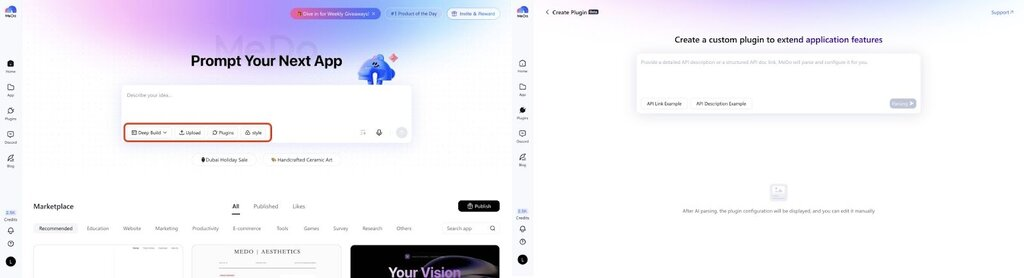
Built-in extensions also expand what can be created. Features such as authentication, payment processing, and AI integrations allow users to move beyond experiments and into products that can actually be monetized.
Rather than limiting projects to simple websites, MeDo also supports SaaS tools, interactive software, and more dynamic experiences such as applications with animations or physics-based interactions. This makes it suitable for users who want room to grow without switching platforms later.
Competitive pricing
Another important factor is accessibility. Many platforms require paid plans before meaningful experimentation is possible. MeDo instead allows users to explore ideas before committing financially.
New accounts receive 300 Credits upon registration, along with 100 Credits for daily usage activity. This allows users to test concepts and refine ideas without immediate cost.
Additional Credits may also be earned through platform activity, which encourages experimentation rather than forcing early purchasing decisions.
This flexible structure matters because product ideas rarely emerge fully formed. Users often need time to test, revise, and rethink their direction.
For those who move beyond experimentation, paid plans begin at $20 per month, providing a gradual upgrade path rather than forcing early commitments.
MeDo vs Lovable vs Base44 vs Replit
| Feature | MeDo | Lovable | Base44 | Replit |
| Platform focus | Complete AI app and site generation | No-code AI product builder | Developer productivity platform | AI-enhanced coding workspace |
| Typical users | Beginners, independent creators, non-technical founders | Product teams and AI-focused builders | Technical or semi-technical users | Professional developers |
| Generation capability | Full frontend, backend, and database creation | Frontend and logic with backend abstraction | Full-stack but requires configuration | Code-driven environment |
| Deployment workflow | Immediate launch without infrastructure setup | Simplified publishing | Requires additional configuration | User-managed deployment |
| Iteration approach | Natural language updates with rollback support | Regeneration-focused workflow | Traditional IDE editing | Version control workflows |
| Monetization and plugins | Built-in payments, auth, and AI tools | Limited native monetization | Integration dependent | External libraries required |
| Interface quality | Interactive UI with motion and feedback | Clean, structured UI | Developer-driven UI | Code-defined UI |
| Ideal project types | SaaS, tools, games, interactive products | MVPs and prototypes | Developer products | Engineering projects |
| Starting cost | $20/month | $25/month | $25/month | $20+/month |
| Beginner accessibility | Very low barrier | Low to moderate | Moderate | Higher technical barrier |
Practical differences that matter in real use
1. Cost efficiency for similar outcomes
For users focused on launching SaaS tools or real applications, MeDo can deliver similar end results to platforms like Lovable while starting at a lower monthly cost. The difference between $20 and $25 per month may seem small, but over long experimentation cycles it becomes meaningful for independent builders and early-stage founders.
2. Greater emphasis on experience and interaction
Many platforms prioritize technical correctness first. MeDo appears to place more attention on how applications feel to users. Generated projects frequently include motion, transitions, and interactive responses, which makes them better suited for customer-facing tools.
3. Designed with beginners in mind
Compared with developer-centric platforms such as Replit or Base44, MeDo reduces the number of decisions users must make about infrastructure. The platform assumes less technical knowledge and focuses on outcomes rather than configuration.
Conclusion
As the no-code AI market grows, many tools compete on features and speed. But in practice, what matters most is whether a platform helps users produce something real.
Many platforms feel accessible at first but still require technical understanding once the initial build is finished. MeDo differentiates itself not through bold claims, but through reducing the hidden steps that often block beginners.
By focusing on generation, iteration, and deployment within one workflow, the platform keeps attention on building useful products rather than managing technical complexity.
For people trying to turn ideas into functional applications without a development background, that practicality may matter more than any individual feature. And ultimately, that focus on real outcomes is what makes MeDo stand apart.
Expand your horizon with this closely aligned perspective at Management Works Media.