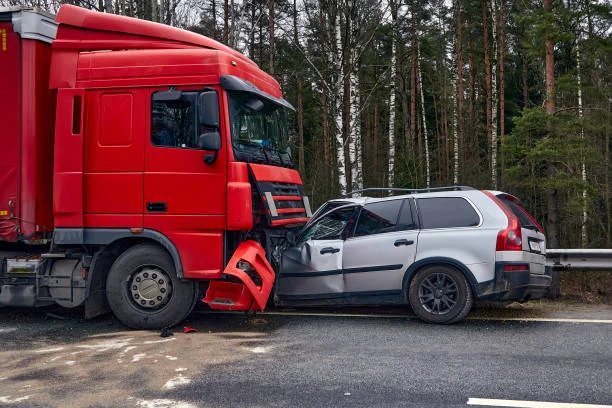
The moment impact occurs involving a commercial vehicle or a large recreational vehicle (RV), your life changes. The metal screams, the glass shatters, and the sheer force of the collision feels fundamentally different from a standard car accident. That is because it is different. You have just survived a collision with a machine that weighs 20 to 30 times more than your vehicle.
If you are reading this, you or a loved one are likely grappling with the aftermath of a crash involving a semi-truck, a bus, or a massive motorhome. You might be recovering in a hospital bed, or worse, grieving a loss. Amidst the trauma, you are likely finding that the insurance process is confusing. Adjusters may be treating this catastrophe like a minor fender-bender, offering quick settlements that don’t begin to cover your medical bills or suffering.
This “David vs. Goliath” dynamic is not just a feeling; it is a statistical reality. In fact, according to 2023 data from the NHTSA, 71% of people killed in large-truck traffic crashes were occupants of other vehicles, not the truck itself.
More Than Just Size
When most people think of “commercial vehicle accidents,” they picture 18-wheelers or delivery box trucks. However, large Recreational Vehicles (RVs), particularly Class A motorhomes, pose the exact same dangers. While an RV looks like a vacation vehicle, it shares the chassis, weight, air brake systems, and handling characteristics of a commercial semi-truck.
This is a critical distinction that many general injury lawyers miss. They treat an RV crash like a car accident because the driver is a vacationer, not a professional trucker. This is a mistake.
Whether it is a commercial semi or a private luxury coach, the legal strategies regarding negligence often overlap. If a driver operates a vehicle of this size without the proper training or while fatigued, the potential for damage is identical, and the legal accountability should be pursued with the same rigor.
Handling these cases correctly requires a commercial vehicle accident lawyer who applies the same rigorous inspection standards used for freight carriers. Because an RV operates on a heavy-duty chassis, the investigation must focus on air brake maintenance, weight-rating compliance, and whether the driver possessed the specific skill set required for a vehicle of that mass. This technical scrutiny is what uncovers the true cause of the collision, providing a factual basis for holding the responsible parties accountable for the full extent of the harm.
Why “I Couldn’t Stop” Is No Excuse
One of the most common defenses a truck or RV driver will offer after a rear-end collision is, “I hit the brakes, but I couldn’t stop in time.” In a standard car accident, this might be argued as a sudden emergency. In a heavy vehicle case, it is often a confession of negligence.
The physics of heavy trucking are immutable. A passenger car weighing 4,000 pounds handles vastly differently than a fully loaded tractor-trailer weighing 80,000 pounds.
As the data shows, a semi-truck needs nearly two football fields to come to a halt at highway speeds. A skilled commercial vehicle accident lawyer uses this data to dismantle the driver’s defense.
If the driver couldn’t stop, physics dictates they were likely:
- Speeding: Exceeding the speed limit, or driving too fast for conditions.
- Following Too Closely: Failing to maintain the “assured clear distance” required for a vehicle of that weight.
- Overloaded: Carrying cargo beyond the legal weight limits, which extends braking distance even further.
Furthermore, professional drivers are held to a higher standard of “reaction time” than average motorists. They are trained to scan further ahead and anticipate hazards. A failure to react promptly isn’t just a mistake; in the eyes of the law, it is a failure of professional duty.
Federal Laws That Prove Negligence
A standard car crash is usually governed by state traffic laws—who ran the red light, who failed to yield. Commercial vehicle accidents, however, are governed by a complex web of federal regulations overseen by the Federal Motor Carrier Safety Administration (FMCSA). These laws are the “unknown unknowns” that a generalist lawyer might miss, leaving money on the table.
Commercial Driver’s Licenses (CDL)
You might assume the driver who hit you was qualified, but was he? Federal law mandates that drivers of vehicles over 26,000 pounds obtain a Commercial Driver’s License (CDL). This requires specialized testing and medical exams.
Depending on the state and the weight of the vehicle, even some RV drivers must possess a CDL or a non-commercial Class A or B license. If the driver who hit you did not have the correct endorsement for their vehicle’s weight class, they were effectively driving illegally.
Hours of Service (HOS)
Fatigue is a leading killer on American highways. To combat this, the FMCSA enforces strict “Hours of Service” rules that limit how long a professional driver can be behind the wheel without a break.
Logbooks and ELDs
How do we know if a driver was tired? We check the logs. Most modern commercial trucks are required to have Electronic Logging Devices (ELDs). These digital logs track exactly when the engine is running and the vehicle is moving.
In many investigations, we find that drivers—pressured by their companies to meet unrealistic delivery windows—falsify these logs or drive “off the books.” Uncovering these discrepancies requires a forensic audit of the data, comparing the logbook against GPS data, toll booth receipts, and fuel station timestamps. A discrepancy here proves the driver was lying, which destroys their credibility in court.
Beyond the Driver: Who Is Actually Responsible?
In a typical car accident, you sue the other driver and their insurance. In a commercial vehicle crash, the driver is often just the tip of the iceberg. To secure the compensation necessary for catastrophic injuries, your attorney must identify every party in the “chain of responsibility.”
The Maintenance Gap
Brake failure or a tire blowout is rarely a “freak accident.” It is usually a failure of maintenance. Trucking companies and bus operators are required to perform pre-trip inspections and regular maintenance. If a mechanic signed off on brakes that were worn down, the maintenance company may be liable for the crash.
Cargo and Loading Companies
If a truck jackknifes or rolls over, it may be due to shifting cargo. Drivers often don’t load their own trailers. If a third-party logistics company stacked the pallets unevenly or failed to secure heavy equipment, causing the center of gravity to shift during a turn, that company shares the blame.
Negligent Hiring
Trucking companies have a duty to vet their drivers. If a company hired a driver with a known history of DUI, reckless driving, or license suspensions, the company itself can be sued for “negligent hiring.” They put a dangerous person behind the wheel of a lethal weapon, and they must be held accountable for that decision.
The Problem with Crashworthiness in RVs
This is a specific area of expertise regarding recreational vehicles. While the chassis of a motorhome is strong, the “house” portion—the living area—is often constructed with lightweight materials like fiberglass and plywood to maximize fuel efficiency.
Unlike passenger cars, which undergo rigorous crash testing, the structural integrity of an RV’s living quarters is often unregulated. In a rollover or severe collision, these structures can disintegrate, causing catastrophic injuries to occupants that wouldn’t have occurred in a standard vehicle. In these cases, the manufacturer may be liable for a product defect—specifically, a lack of crashworthiness.
Conclusion
A crash involving a semi-truck or large RV is a complex legal battle involving federal laws, engineering physics, and corporate defendants. You are not just fighting a driver; you are likely facing a logistics company, an insurance conglomerate, and a legal team whose sole job is to minimize your payout.
Do not face this alone. You need an advocate who knows the difference between a car wreck and a heavy machinery failure—someone who can interpret the black box data, audit the driver’s logbooks, and hold every negligent party responsible.