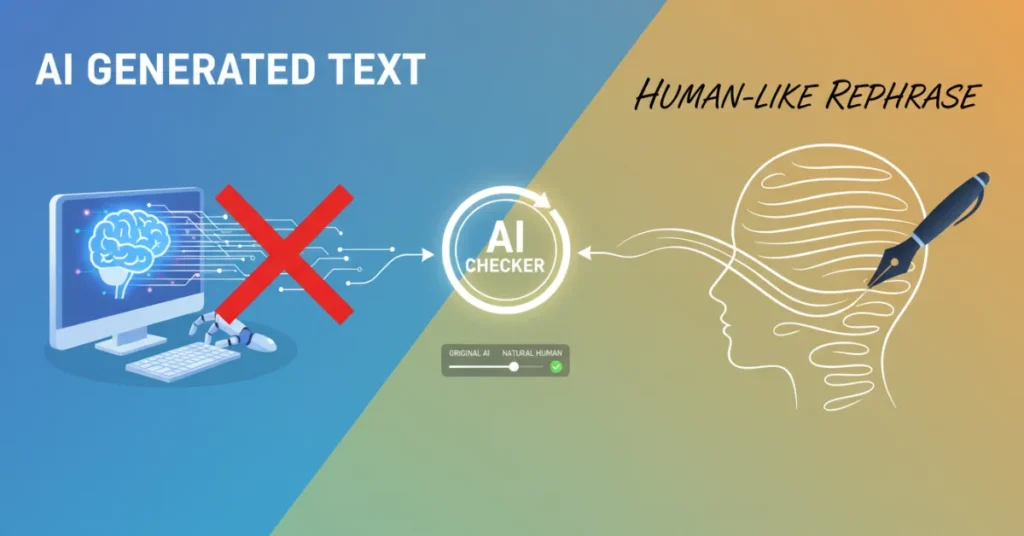
AI makes writing easier, but it also changes how people read. Editors pause longer. Teachers scrutinize phrasing. Clients ask for “one more revision” without saying why. Dechecker fits into that awkward space between draft and delivery AI Checker. It helps writers check, adjust, and release AI-assisted text that feels deliberate instead of automated.
Where AI Writing Usually Starts to Go Wrong
The draft looks complete, but confidence drops
Most AI-assisted drafts reach a point where nothing is obviously broken. The argument flows, grammar checks pass, and formatting looks clean. Yet many writers hesitate before hitting publish or submit. That hesitation usually isn’t emotional; it’s experiential. Something about the language feels too smooth, too neutral, too expected.
This is often when an AI Checker becomes part of the workflow. It doesn’t replace judgment. It clarifies it. The tool highlights where the text leans heavily on common AI patterns rather than intentional phrasing.
Why “it sounds fine” isn’t reassuring anymore
Readers today encounter AI-generated language constantly. Over time, they learn its rhythms. When a text follows those rhythms too closely, it blends into everything else. Writers sense this even if they can’t articulate it immediately. An AI Checker turns that vague discomfort into something actionable.
Ignoring that instinct usually costs engagement.
Deadlines make guessing expensive
Under time pressure, writers often publish first and revise later. That works until feedback becomes unclear or performance drops AI Checker. Dechecker helps reduce that risk by giving writers a clearer signal before the content leaves their control.
How Dechecker Approaches AI Detection in Practice
Detection without drama
Some detection tools frame results as exposure. Dechecker doesn’t. Its AI Checker focuses on likelihood and structure, not accusation. The output feels closer to an editorial note than a warning label.
That tone matters because it keeps writers focused on improvement, not defense.
What the signals actually point to
High AI likelihood often traces back to repeatable traits. Sentences settle into similar lengths. Transitions rely on predictable phrases. Claims stay balanced but vague. Dechecker surfaces these traits so writers understand why a section feels generic.
Understanding the cause speeds up revision.
Choosing what to fix and what to leave
Not every flagged sentence needs rewriting. Dechecker helps writers see where changes will have the most impact. Introductions, summaries, and persuasive sections usually matter more than descriptive passages.
That selectivity keeps the process efficient.
Revising AI Content Without Losing Control
Why aggressive rewriting usually backfires
After seeing detection results, many writers overcorrect. They rewrite entire sections, add unnecessary complexity, or change tone too much. The result often sounds edited rather than improved. Meaning drifts. Authority weakens.
Effective revision focuses on clarity and intent, not novelty.
Where AI Humanizer fits into the workflow
Once detection shows where the text feels mechanical, rewriting becomes targeted. This is where the AI Humanizer fits naturally. It reshapes sentence rhythm and phrasing without rewriting ideas, helping the text feel intentional rather than generated.
Used at the right moment, it feels like tightening a draft, not transforming it.
Knowing when to stop editing
One underrated skill is stopping. Dechecker doesn’t push endless refinement. When AI patterns soften and the text reads smoothly, writers can move on. That clarity prevents revision loops that drain time and confidence.
A Practical Example from Content Creation
The first version
A content team produced a long blog post using AI for speed. The structure worked, but internal reviewers kept asking for changes without specifics. The tone felt “off,” but no one could define why.
Running the post through an AI Checker showed several sections with strong AI pattern signals, especially the opening and conclusion.
Targeted changes, not a full rewrite
Instead of rewriting everything, the team focused on those sections. They adjusted sentence flow, added concrete examples, and varied transitions. The core content stayed the same.
The revised draft passed review immediately.
What actually changed
Nothing dramatic. The text simply sounded like someone made choices while writing it. That difference mattered more than length or keywords.
Academic and Educational Use Cases
Students navigating new expectations
Students increasingly use AI for outlines or first drafts. The concern isn’t originality; it’s perception. Even genuine work can raise questions if the language feels overly neutral or templated.
An AI Checker helps students review tone before submission, reducing unnecessary suspicion.
Improving clarity without rewriting ideas
Most assignments don’t need new arguments. They need clearer ownership. Dechecker highlights where language feels impersonal, allowing students to revise selectively and keep their ideas intact.
Grades improve because communication improves.
Helping educators focus on learning
For instructors, Dechecker offers a way to discuss writing quality without assumptions. Instead of guessing whether a text is AI-written, they can point to observable patterns and guide improvement.
That changes the conversation.
Marketing and Professional Writing
Scaling content without sounding mass-produced
Marketing teams rely on AI to meet volume demands. Over time, assets start to resemble each other too closely. AI Checker helps identify repeated phrasing and structural sameness across drafts.
Variation becomes intentional, not accidental.
When tone affects conversion more than features
Users decide quickly whether content feels worth reading. Pages that sound generated often fail to persuade, even with strong offers. Dechecker helps teams spot where copy lacks urgency or specificity and refine those sections.
Small tonal changes can shift outcomes.
Business documents that need ownership
Proposals, reports, and internal memos often start with AI drafts. Stakeholders expect accountability, not templates. Dechecker helps identify sections that sound assembled rather than authored.
Rewriting those areas restores authority.
SEO and Long-Term Performance
Engagement signals don’t ignore tone
Search engines increasingly reward engagement. Content that feels human keeps readers longer. AI-generated text left unrefined often underperforms quietly.
Using an AI Checker helps adjust tone before analytics reveal the problem.
Avoiding structural predictability
AI favors balance. Paragraphs align neatly. Headings mirror each other. While clean, this symmetry can feel artificial. Dechecker highlights excessive regularity so writers can introduce variation deliberately.
That subtle imbalance feels more natural.
Preparing for algorithm changes
Algorithms change, but quality signals persist. Content refined through detection and careful rewriting avoids extremes that updates often target. Longevity becomes a practical advantage.
Building Dechecker Into a Real Workflow
Separating creation from validation
AI drafts accelerate creation. Dechecker handles validation. Treating these as separate steps reduces confusion and anxiety. AI Checker becomes a checkpoint, not a gatekeeper.
Writers stay in control.
Learning through repetition
Over time, writers anticipate what Dechecker will flag. Sentence variety improves naturally. Transitions become more deliberate. The tool trains awareness, not dependence.
Skills compound across projects.
Publishing without second-guessing
The biggest benefit is confidence. When content passes detection and targeted revision, hesitation fades. Writers publish knowing the text reflects decisions, not defaults.
That confidence shows in how the content performs.
Writing That’s Ready for Real Readers
AI isn’t the problem. Unfinished refinement is. Dechecker supports the final stage where writing becomes credible. With AI Checker clarifying risk and thoughtful rewriting restoring tone, content moves from usable to publishable.
And that difference is what real readers notice first at Management Works Media.