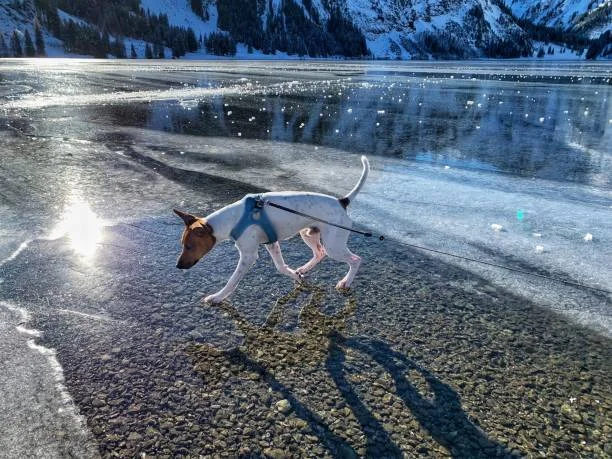
In Minnesota, the freezing of the lakes is a cultural event. It marks the transition from boat season to ice-house season. For residents of Prior Lake, the Frozen Lake Safety for Pets surface of the water becomes an extension of the backyard. It transforms into a vast, white dog park where pets can run for miles without a leash, chasing snowballs and sliding across the vast expanse.
It looks like solid ground. It feels like solid ground. But to a physicist—and to the Scott County Sheriff’s deputies who perform the rescues—it is a dynamic, shifting sheet of glass.
Every winter, tragic stories emerge of dogs falling through the ice. Often, the owners are baffled because they had walked on that same spot just days before, or because they saw a snowmobile cross safely nearby.
The mistake lies in assuming that ice is static. To keep our dogs safe, we have to stop looking at the lake as a floor and start understanding it as a living, breathing system of thermodynamics and pressure.
Discover secrets hidden in plain sight—click to explore now!
The “Paws vs. Boots” Physics
The first danger is a simple math problem: Pounds Per Square Inch (PSI).
When a human walks onto a frozen lake, they are usually wearing heavy winter boots. Frozen Lake Safety for Pets boots have a large surface area. If a 180-pound man stands on the ice, his weight is distributed across roughly 60 to 80 square inches of sole.
Now, consider a 70-pound Labrador.
The dog weighs less than the man, so we assume the dog is safer. But a dog stands on four paws. The actual contact patch of a dog’s paw is tiny—perhaps only 2 to 3 square inches per foot. When a dog runs, they are often only contacting the ground with two feet at a time during their stride.
This means the dog is driving 70 pounds of force into a surface area the size of a tennis ball. The PSI exerted by a running dog can actually be higher than that of a walking human. A dog acts like a frantic, four-legged ice pick. If there is a weak spot, the human might bridge over it, but the dog will punch right through it.
The Treachery of Currents and Springs
The second misconception is uniformity. We tend to think that if the ice is 12 inches thick near the boat launch, it is 12 inches thick in the middle.
However, lakes are not swimming pools. They have currents. Prior Lake, specifically, is part of a complex watershed. Water is constantly moving beneath the surface, flowing from inlets to outlets.
Moving water does not freeze as easily as still water. Wherever there is a current—narrow channels between islands, bridges, or culverts—the warmer water from the bottom is churned up to the surface. This friction eats away at the ice from underneath.
Furthermore, underwater springs bubble up from the lake bed. These springs bring 50-degree groundwater up to the surface, creating “chimneys” of paper-thin ice that are invisible from above because they are covered by a layer of insulating snow. A dog chasing a frisbee doesn’t know about hydrology. They hit these hidden chimneys at full speed.
The Methane Factor
There is an even stranger enemy lurking in the mud: rotting vegetation.
Lakes are full of decaying weeds and muck. As this organic matter breaks down in the oxygen-deprived environment of winter, it releases methane gas.
You have likely seen bubbles trapped in the ice. Those are often methane. If a large pocket of gas rises to the surface as the ice is forming, it creates a void. The ice might form a thin skin over the gas bubble, creating a fragile dome. These “gas holes” are notoriously weak and are often found near marshy shorelines—exactly where dogs love to sniff and explore.
The “Cold Shock” Response
If the physics fails and a dog breaks through, biology takes over. And the biology of a dog in ice water is terrifying.
When a warm-blooded mammal hits 33-degree water, the body undergoes an involuntary “Cold Shock Response.” The victim gasps. If the dog’s head goes under, that gasp fills the lungs with water immediately.
Even if they keep their head up, the clock starts ticking. A dog has very little fat on its legs. The cold water constricts the blood vessels instantly to save the core organs. The muscles in the legs seize up within minutes.
The most heartbreaking aspect of these scenarios is the “Claw Failure.” A dog’s claws are designed to dig into dirt, not grip wet glass. When a dog tries to climb out of an ice hole, their front paws slip. They panic, scrabbling frantically, which exhausts their remaining energy reserves in seconds.
The “Two-Victim” Tragedy
This leads to the human element. The vast majority of human deaths related to ice rescues occur because the owner tries to save the dog.
It is an overwhelming instinct. You see your family member struggling, and you run out to help. But by running, you are adding massive impact force to the already compromised ice. The result is almost always a “Two-Victim” incident.
Fire departments train extensively for this. They never run out; they crawl, distributing their weight, pushing ladders or sleds ahead of them. A dog owner in a parka has none of this equipment.
The Safe Alternative
So, does this mean you can never enjoy the winter beauty of the lake? Not necessarily. But it requires a shift in risk assessment.
- Wait for the Cars: A good rule of thumb is that if you don’t see pickup trucks parked on the ice, don’t walk your dog on it.
- Keep the Leash On: The middle of the lake is not a dog park. If you are ice fishing, keep your dog tethered near the thickest ice, rather than letting them roam to the shoreline where conditions vary.
- Know the Seasons: Early ice (December) and late ice (March/April) are the widow-makers. The freeze-thaw cycles make the ice “rotten” (vertical candling), where it loses all structural integrity despite looking thick.
Conclusion
The winter in Minnesota is long, and our dogs need exercise. It is tempting to look at the vast, open white space of the frozen lake as the perfect solution to cabin fever. But the variables involved—currents, gas pockets, and point-loading pressure—make it a gamble every time you unclip the leash.
Sometimes, the smartest choice is to skip the risk entirely. Utilizing a structured, climate-controlled environment like a professional dog boarding Prior Lake MN facility allows your dog to burn off that winter energy on safe, solid ground, ensuring that the only thing breaking this winter is a sweat, not the ice.