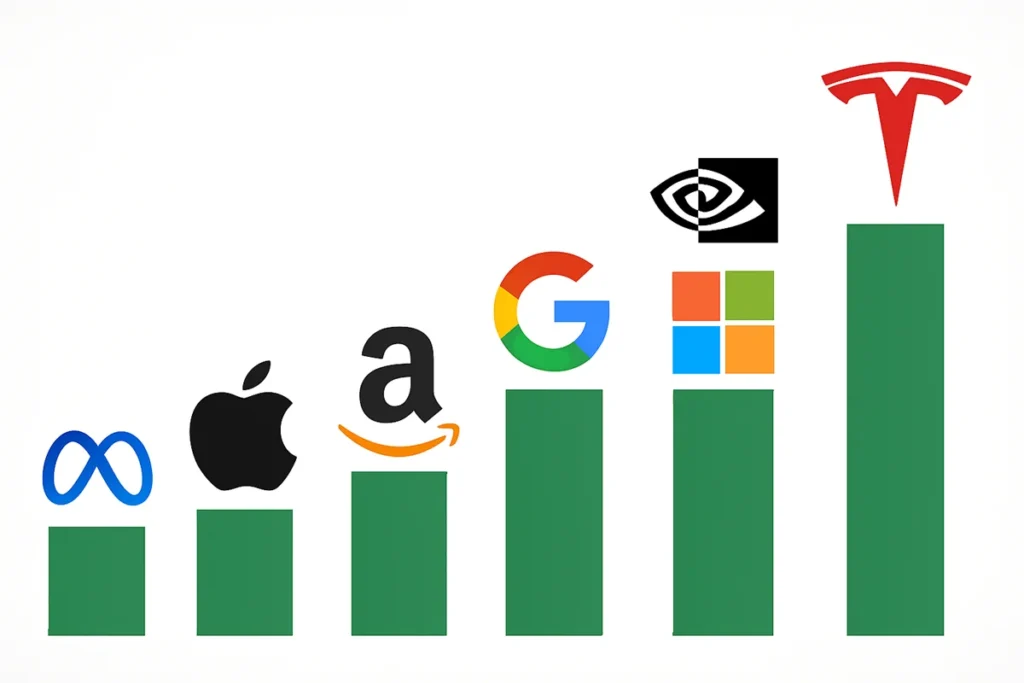
The stock market has become increasingly concentrated around a small group of dominant companies. This article explores how far the performance gap has stretched between the Magnificent Seven and the other 493 companies in the S&P 500, and what this imbalance means for investors and the broader economy.
The Growing Divide in Market Performance
Over the past few years, the group widely known as the mag 7 has reshaped the S&P 500’s trajectory. These companies, driven by strong earnings, technological leadership, and massive scale, have grown so influential that they often determine whether the entire index posts gains or losses on any given day. While some level of concentration is typical in equity markets, the magnitude of today’s imbalance is unusual. The combined weight of these seven stocks has climbed to historic highs, creating an outsized impact on index returns and volatility.
The core of the gap comes from remarkable earnings power. These companies operate in sectors where network effects, data advantages, and automation allow them to expand without proportionate increases in cost. As a result, their profit margins sit well above the index average, which supports higher valuations during both stable and uncertain economic cycles. The rest of the S&P 500 includes many strong businesses, yet few share the same scalability or global dominance. This difference in structural advantages has helped widen the gap year after year.
Why Concentration Has Accelerated
Several forces have amplified the separation between the leaders and the rest of the index. First is the broad adoption of artificial intelligence and cloud infrastructure. Companies with heavy investments in AI capabilities, advanced chips, and cloud computing platforms have benefited from a surge in enterprise and consumer demand. This shift strongly favors mega cap tech companies, pushing their valuations and revenues higher at a faster rate.
Second, passive investing has reinforced concentration. As more money flows into index funds, the largest companies receive the biggest share of new capital. This means any outperformance by the top seven stocks compounds quickly. The momentum becomes self reinforcing, making it challenging for mid cap or even large cap companies to catch up.
Third, global economic uncertainty tends to push investors toward companies perceived as safe or resilient. The Magnificent Seven enjoy strong balance sheets, large cash reserves, and diversified revenue streams. When markets grow volatile, investors often rotate into these leaders rather than smaller firms with less predictable earnings. This behavior has strengthened their dominance even during periods when other companies struggled.
How the Rest of the S&P 500 Compares
While the Magnificent Seven dominate headlines, the rest of the S&P 500 still represents essential parts of the U.S. economy, from banks and manufacturers to energy, health care, and retail. Many of these companies offer steady dividends and long term stability, though they lack the rapid acceleration seen in the top seven stocks.
A key difference is earnings growth. The leaders regularly post strong double digit gains, while the broader index grows more slowly, creating a clear valuation gap. Their performance is also more tied to global tech trends like AI and cloud, whereas many other companies depend on cyclical forces such as interest rates and consumer spending.
Even so, the remaining 493 provide opportunities. Many trade at more reasonable valuations and offer defensive qualities that can help diversify portfolios and balance tech driven market swings.
Is the Gap Sustainable?
The central question is whether the current imbalance can persist. Historically, periods of extreme concentration eventually normalize. Leadership rotates, new technologies emerge, and changing economic conditions shift investor priorities. While the Magnificent Seven have real competitive advantages, they may not maintain this level of dominance forever.
One potential trigger for change is regulatory pressure. Governments across the United States and Europe are increasingly focused on antitrust concerns in the technology sector. Any regulatory action that limits expansion, acquisitions, or data control could impact the long term growth outlook of the top seven companies.
Another possibility is earnings deceleration. If growth in AI, cloud, or digital services slows, valuations may compress. Even a modest cooling of expectations could reduce the performance gap and give more room for other sectors to recover.
On the other hand, if AI driven demand continues to accelerate, the Magnificent Seven may maintain their leadership for longer than expected. Their size, resources, and technological capabilities position them well to remain at the center of the next decade of innovation.
Final Thoughts
The gap between the Magnificent Seven and the rest of the S&P 500 is wide and still evolving. While the top companies benefit from powerful structural advantages, the broader market remains full of resilient performers that contribute significantly to long term economic health. Understanding both sides of the divide can help investors make better decisions as the market continues to reshape itself.
Your next insight is waiting—explore more stories crafted for curious minds.